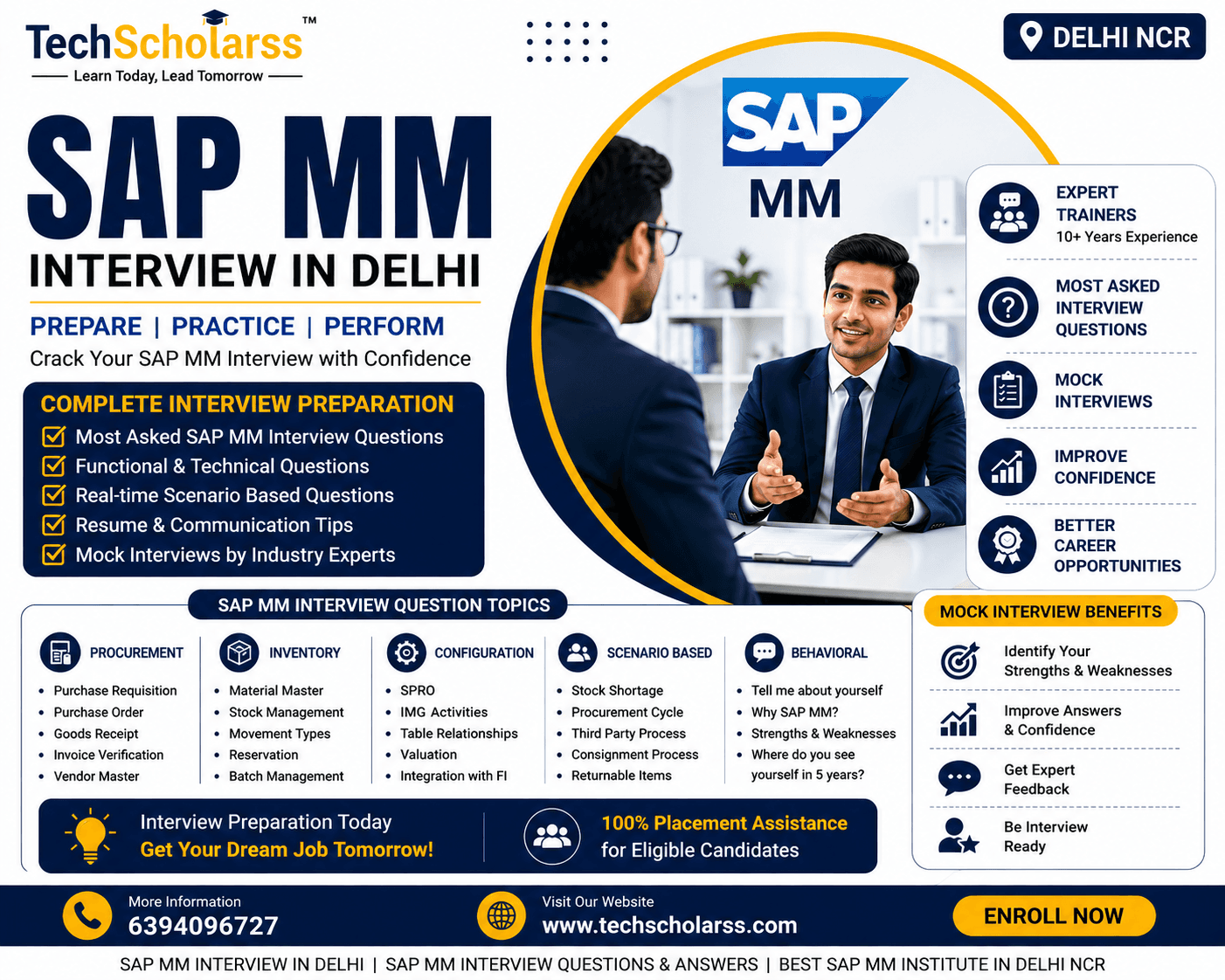
SAP MM Interview Preparation
Most SAP MM interviews follow a fairly predictable pattern: they start with basic concept checks, move into process-specific questions on procurement and inventory, test your understanding of integration points, and finish with a scenario-based question to see how you'd actually apply the knowledge.
Preparing around this structure — rather than memorizing a long list of disconnected questions — tends to hold up better under follow-up questions, since interviewers often probe deeper into whichever topic you answer confidently.
Basic SAP MM Interview Questions
These fundamental questions are almost always asked early in an SAP MM interview:
- •What is SAP MM? — SAP MM (Materials Management) is the module responsible for procurement and inventory management, covering everything from purchase requisitions to goods receipt and invoice verification.
- •What is a Plant in SAP? — A Plant is an organizational unit where materials are produced, stored, or distributed within a company code.
- •What is a Storage Location? — A Storage Location is a subdivision of a plant where physical inventory is managed and stocked.
- •What is a Purchasing Organization? — A Purchasing Organization is the organizational unit responsible for procurement activities, negotiating conditions with vendors.
- •What is the Material Master? — The Material Master is the central repository of all data related to a specific material, used across procurement, sales, and inventory processes.
Organizational Structure Questions
These questions test whether you understand how SAP MM's organizational units relate to each other:
- •How is a purchasing organization linked to a company code and plant?
- •What is the difference between a centralized and decentralized purchasing organization?
- •What is a purchasing group, and how does it differ from a purchasing organization?
Procurement Process Questions
Procurement questions typically probe your understanding of the full purchase cycle:
- •What is the difference between a Purchase Requisition and a Purchase Order?
- •What is an RFQ (Request for Quotation), and when is it used?
- •What are the different types of purchase orders in SAP MM?
- •What is a scheduling agreement, and how does it differ from a contract?
- •How does source determination work during procurement?
Inventory Management Questions
Inventory questions focus on stock and goods movement:
- •What is a goods receipt, and what movement types are commonly used?
- •What is the difference between unrestricted, blocked, and quality inspection stock?
- •How is physical inventory managed and reconciled in SAP MM?
- •What is the difference between a goods issue and a goods receipt?
Want Hands-On Practice Before Your Interview?
Build real configuration project experience with live S/4HANA access on our main course page.
Explore SAP MM Course in Delhi →Pricing Procedure Questions
These questions test your understanding of how pricing is configured for procurement:
- •What is a condition type, and how is it used in the pricing procedure?
- •What is the difference between a pricing procedure and a condition record?
- •How are taxes and freight conditions handled in the MM pricing procedure?
Vendor & Master Data Questions
Vendor and master data questions cover the data foundations of procurement:
- •What is a Vendor Master, and what data does it contain?
- •What is a Purchasing Info Record, and how does it relate to source determination?
- •How is vendor evaluation performed in SAP MM?
SAP MM Integration Questions
Integration questions test whether you understand how MM connects to other modules — a common weak spot for candidates who've only studied MM in isolation:
- •MM-FI Integration: How does a goods receipt or invoice receipt in MM trigger postings in Financial Accounting?
- •MM-SD Integration: How does stock availability in MM affect order fulfillment in Sales & Distribution?
- •What automatic account determination settings link MM transactions to the correct GL accounts?
Scenario-Based SAP MM Questions
Scenario questions are where experienced candidates are most tested, since they simulate real project problems:
- •A goods receipt was posted against the wrong purchase order — walk through how you'd identify and correct this.
- •Invoice verification shows a price mismatch with the purchase order — how would you investigate it?
- •A new plant needs to go live next month — what MM configuration steps would you prioritize?
- •Users report that stock quantities don't match between the warehouse and SAP — what would you check first?
SAP MM Interview Questions for Freshers
Freshers are typically tested more heavily on fundamentals and basic process understanding rather than deep scenario-based problems. Expect a strong focus on core concepts (organizational structure, master data), the basic procurement cycle, and simple configuration questions rather than complex, multi-module scenarios.
Being able to explain why a process step matters — not just define it — tends to leave a stronger impression than a memorized textbook answer.
SAP MM Interview Questions for Experienced Candidates
Experienced candidates are questioned more on integration, real project scenarios, and design decisions — for example, why a particular configuration approach was chosen on a past project, how a specific issue was resolved, or how they'd approach a new implementation from blueprinting onward.
Interviewers at this level are often less interested in textbook definitions and more interested in how you think through ambiguous, real-world problems.
Common Interview Mistakes
A few mistakes come up repeatedly across SAP MM interviews:
- •Giving textbook definitions without connecting them to practical configuration steps
- •Not being able to explain integration points with FI and SD
- •Struggling with scenario-based questions due to lack of real project or practice exposure
- •Being unfamiliar with S/4HANA-specific changes when the role requires it
- •Not preparing specific examples from training projects to speak to during behavioral questions
Frequently Asked Questions
What are the most common SAP MM interview questions?+
The most common questions cover basic concepts (organizational structure, master data), procurement and inventory processes, pricing, integration with FI/SD, and scenario-based problem solving.
Are SAP MM interview questions different for freshers and experienced candidates?+
Yes. Freshers are tested more on fundamentals and basic processes, while experienced candidates face more integration and scenario-based questions tied to real project experience.
What is asked in SAP MM procurement interview questions?+
Procurement questions typically cover the difference between purchase requisitions and purchase orders, RFQs, scheduling agreements, and source determination.
What is asked in SAP MM inventory interview questions?+
Inventory questions typically cover goods receipt, goods issue, stock types, and physical inventory reconciliation.
How important are integration questions in SAP MM interviews?+
Very important — MM-FI and MM-SD integration questions are common, since they test whether a candidate understands SAP MM beyond an isolated module view.
How can I prepare for scenario-based SAP MM questions?+
Hands-on practice with real configuration projects during training is the most effective preparation, since these questions test applied problem-solving rather than definitions.
Where can I learn the SAP MM syllabus before my interview?+
See the complete module-wise SAP MM syllabus for a structured breakdown of what to revise before interviews.