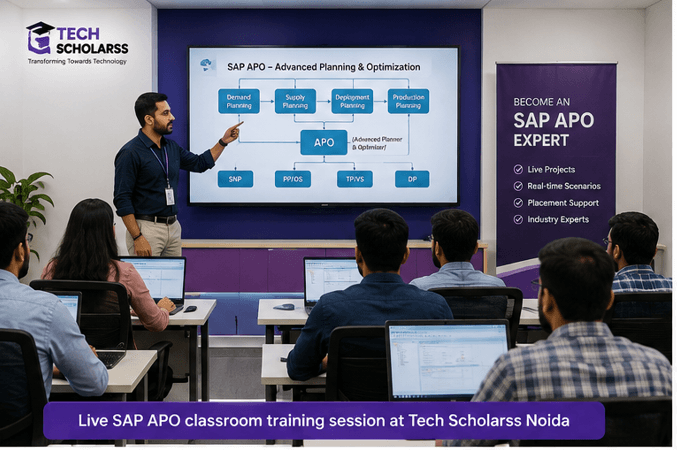
What Is SAP APO?
SAP APO (Advanced Planning and Optimization) is SAP's supply chain planning suite used for demand forecasting, supply network planning, production scheduling, and order fulfillment checks on top of a company's core ERP system.
APO covers demand-side planning (Demand Planning), supply-side planning (SNP, PP/DS), and order promising (gATP), tied together with the Core Interface (CIF) that keeps master and transaction data in sync with ECC or S/4HANA.
SAP APO Course Syllabus
A complete, job-focused SAP APO syllabus is typically organized into the following 12 modules:
- •Module 1 – Introduction to Supply Chain & APO: SCM overview, APO landscape, liveCache basics
- •Module 2 – Core Interface (CIF): Integration models, master data and transaction data transfer
- •Module 3 – Demand Planning (DP) Basics: Planning books, data views, key figures
- •Module 4 – DP Forecasting: Univariate and causal forecasting models, macros
- •Module 5 – Supply Network Planning (SNP) Basics: Planning books, heuristics
- •Module 6 – SNP Optimizer & Deployment: Constraints, costs, deployment and TLB
- •Module 7 – Production Planning/Detailed Scheduling (PP/DS): Heuristics, optimizer, PP/DS planning board
- •Module 8 – Global ATP (gATP): Product availability check, rules-based ATP
- •Module 9 – Introduction to SAP IBP: How IBP relates to and extends classic APO capabilities
- •Module 10 – Projects & Placement Preparation: Real planning scenarios, resume and interview prep
- •Module 11 – Review & Mock Interviews: Scenario-based interview questions, common pitfalls
- •Module 12 – Final Assessment & Certification: Hands-on assessment, certification issuance
This module structure mirrors the curriculum followed on the main course page. View curriculum →
Demand Planning in SAP APO
Demand Planning is where forecasting happens — using planning books, key figures, and both statistical (univariate) and causal forecasting models to predict future demand. A good syllabus spends significant time on macros and planning book customization since these are used heavily in day-to-day forecast adjustment work.
Supply Network Planning (SNP)
SNP covers mid-term supply planning — balancing demand against available capacity and constraints across plants, distribution centers, and suppliers using heuristics or the SNP optimizer, followed by deployment to convert the supply plan into execution-ready quantities. This module is tested frequently in interviews since it requires understanding trade-offs between cost, capacity, and service level together.
Production Planning / Detailed Scheduling (PP/DS)
PP/DS handles short-term, detailed scheduling at the shop-floor level — sequencing orders on the PP/DS planning board, applying heuristics or the optimizer, and resolving resource and material constraints. This module also covers when to use heuristics versus the optimizer, which is a common scenario-based interview topic.
Want the Full SAP APO Curriculum?
See the detailed module-wise curriculum, live planning scenarios, and batch timings on our main course page.
Explore SAP APO Course in Noida →SAP APO & ECC/S4HANA Integration
APO rarely runs in isolation — understanding how it connects to the core ERP is often what separates a strong candidate from an average one.
- •APO + CIF: Keep master data (materials, locations, resources) and transactions (orders, stocks) in sync between APO and ECC/S4
- •APO + gATP: Check product availability in real time against ECC sales orders
- •APO + IBP: Understand how IBP is positioned as the cloud successor covering similar planning functions
Practical SAP APO Scenarios
Modules alone don't prepare you for interviews — real planning scenarios do. A good SAP APO program includes hands-on scenario work such as building a demand plan and running a forecast, executing an SNP heuristic run and reviewing deployment, configuring a PP/DS scheduling scenario, and setting up a basic gATP check.
The most valuable scenarios are the ones that combine DP output feeding into SNP and then PP/DS, since that's where most real-world planning cycles — and most interview questions — actually happen.
SAP APO Course Duration
Covering all 12 modules properly, along with hands-on planning practice and scenario work, typically takes 4–5 months when taught progressively. Shorter crash courses exist but usually compress or skip PP/DS and gATP modules, which limits how job-ready you are at the end.
Who Should Learn SAP APO?
This syllabus works well for B.Tech, MBA (Operations/Supply Chain), and B.Com graduates, since the module structure closely follows planning concepts they've already studied. Working professionals moving from SAP MM/PP/SD functional roles, and planners looking to move into SAP consulting, also fit well into this curriculum.
If you're from a non-supply-chain background, look for a course that spends time on core planning concepts in Module 1 before moving deeper into APO-specific configuration.
SAP APO Career Opportunities
This syllabus maps directly to roles such as SAP APO Consultant, Demand Planning Analyst, SNP Consultant, and SAP IBP Consultant. Demand for these roles comes largely from IT consulting firms and SAP implementation partners running supply chain planning projects.
See the full career breakdown here: View curriculum →
How to Choose an SAP APO Course
When comparing syllabuses across institutes, it's worth checking a few things directly:
- •Does the syllabus include PP/DS and gATP in depth?
- •Is SAP IBP covered even briefly, or only classic APO?
- •How many real planning scenarios and projects are included in the course?
- •Is training delivered with live planning book access, or only theory/slides?
- •Are trainers implementation-qualified, not just SAP-technical trainers?
Frequently Asked Questions
What is included in the SAP APO syllabus?+
The syllabus covers 12 modules — supply chain and APO basics, CIF integration, Demand Planning, SNP, PP/DS, gATP, an IBP introduction, and a final projects module.
How long does it take to complete the SAP APO syllabus?+
A complete, progressively taught program covering all 12 modules with hands-on practice typically takes 4–5 months.
Does the syllabus include PP/DS?+
Yes, Module 7 covers Production Planning/Detailed Scheduling — heuristics, the optimizer, and the PP/DS planning board.
Is SAP IBP covered in the syllabus?+
Yes, Module 9 gives an introduction to SAP IBP and how it relates to classic APO capabilities.
Are real planning scenarios included in the syllabus?+
Yes, Module 10 includes hands-on planning scenarios along with resume and interview preparation.
Is this syllabus suitable for non-supply-chain graduates?+
Yes, as long as the course covers core planning fundamentals early on before moving into APO-specific configuration.
Where can I check the SAP APO course fees?+
See the detailed SAP APO course fees guide for what's typically included in the fee across different program types.