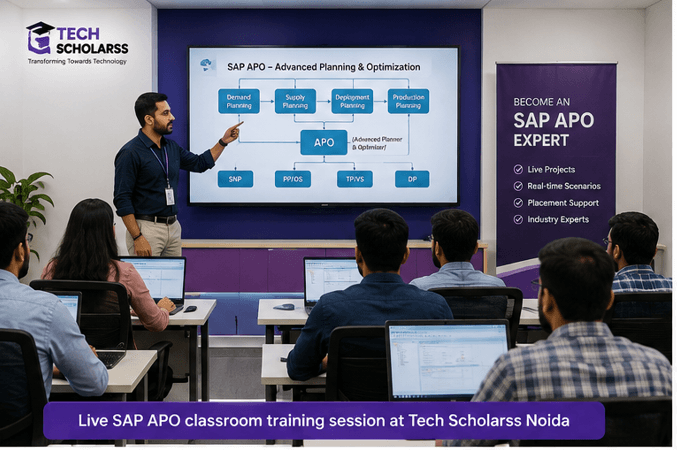
SAP APO Career Opportunities
SAP APO remains a relevant supply chain planning skill because organizations running SAP still operate live APO landscapes alongside newer IBP rollouts — planning knowledge from APO transfers directly. This creates steady opportunities across consulting firms, SAP implementation partners, and in-house supply chain teams at large enterprises.
Opportunities generally fall into three buckets: implementation projects (configuring planning modules for a company's supply chain rollout), support and maintenance (handling planning issues and change requests on an existing APO system), and migration projects (moving planning processes from APO to SAP IBP).
Why SAP APO Has Career Opportunities
A few structural reasons keep demand for SAP APO professionals steady:
- •Many large enterprises still run live APO systems even as they plan IBP migrations, so support and rollout work continues
- •Ongoing IBP migrations mean companies need consultants who understand classic APO logic to map it correctly to IBP
- •Supply chain disruptions in recent years have pushed companies to invest more in planning and forecasting capability
- •Consultants who understand both DP/SNP/PP-DS and how they map to IBP are relatively scarce compared to APO-only talent
SAP APO Job Roles
Within SAP APO, the day-to-day work looks quite different depending on the specific role:
- •SAP APO Consultant — configures and maintains APO modules based on business requirements from supply chain stakeholders
- •Demand Planning Analyst — manages forecast models, planning books, and demand review cycles
- •SNP Consultant — handles supply planning configuration, heuristics, optimizer runs, and deployment
- •SAP IBP Consultant — extends planning knowledge into SAP's cloud-based IBP platform
SAP APO Career Path for Freshers
Most freshers enter SAP APO through support or junior consultant roles, since these positions rely more on solid planning fundamentals than years of implementation experience. A typical starting point is a support role handling day-to-day planning issues on a live client system, which builds real exposure to how planning cycles actually run in production — something a course alone can't fully replicate.
From there, freshers usually move into implementation project roles within 1–2 years, once they've built confidence with planning book configuration, heuristics, and client communication.
SAP APO Career Path for Experienced Professionals
With a few years of implementation experience, SAP APO consultants typically move toward senior consultant or solution architect roles, where they own the design of the planning solution across a full project rather than just executing individual configuration tasks.
Some professionals also specialize further — moving into SAP IBP-focused consulting, or SNP/PP-DS optimizer specialization — while others move toward supply chain solution architecture roles, using their APO background to design the overall planning landscape.
Ready to Start Your SAP APO Career?
See the complete curriculum, real planning scenarios, and placement support on our main course page.
Explore SAP APO Course in Noida →SAP APO Skills Required
Beyond the core module configuration knowledge, a few skills consistently separate strong SAP APO professionals:
- •Solid supply chain planning logic — not just APO-specific transaction codes
- •Understanding of heuristics vs optimizer trade-offs and when to use each
- •Familiarity with CIF integration for troubleshooting master/transaction data issues
- •Working knowledge of SAP IBP, since APO-only skills are increasingly limiting
- •Client communication ability for translating planning requirements into working configuration
SAP APO Jobs in Noida and NCR
Noida and the broader NCR region host a large number of IT consulting firms and SAP implementation partners, many of which run supply chain planning projects for both domestic and global clients. This makes it a reasonably active market for SAP APO roles, particularly at the support and junior consultant level.
That said, plenty of SAP APO and IBP roles today are remote or hybrid, so consultants trained in Noida aren't limited to opportunities within the city alone.
SAP APO Salary in India: Fresher to Experienced
As a general industry pattern, freshers often start around ₹4–7 LPA, professionals with about 2–3 years of experience move into the ₹9–14 LPA range, and consultants with 5+ years of implementation exposure can reach ₹18–26 LPA or more. Salary tends to track hands-on implementation and planning experience more closely than certifications alone.
These figures are indicative and vary by city, employer, and individual project background — treat them as a general guide rather than a fixed benchmark.
How to Start a Career in SAP APO
A practical starting sequence looks like this: build core supply chain planning fundamentals if you don't already have them, complete a structured SAP APO course that includes real planning scenarios, get comfortable with how APO integrates with ECC/S4 and where IBP fits in, and target support or junior consultant roles first rather than holding out for a senior role straight away.
Real scenario exposure — even in a training environment — matters more to hiring managers than certificates alone, since interviews tend to probe how you'd handle specific planning and configuration scenarios.
Common Mistakes Freshers Should Avoid
A few avoidable mistakes come up repeatedly among SAP APO freshers:
- •Learning only Demand Planning and skipping SNP/PP-DS exposure
- •Treating SAP APO as pure transaction-code memorization and neglecting core planning logic
- •Skipping gATP because it seems optional early on
- •Ignoring how APO connects to SAP IBP in the current market
- •Choosing a course purely on price without checking scenario and placement support
Frequently Asked Questions
What jobs can I get after learning SAP APO?+
Common roles include SAP APO Consultant, Demand Planning Analyst, SNP Consultant, and SAP IBP Consultant, typically at IT consulting firms and SAP implementation partners.
Is SAP APO a good career option for freshers?+
Yes. Freshers with a basic supply chain background can start in support or junior consultant roles and move into implementation projects within 1–2 years.
What skills are required for an SAP APO career?+
Solid supply chain planning fundamentals, APO configuration and troubleshooting skills, understanding of heuristics vs optimizer, and increasingly, familiarity with SAP IBP.
What is the salary range for SAP APO professionals in India?+
As a general pattern, freshers often start around ₹4–7 LPA, professionals with about 2–3 years of experience move into ₹9–14 LPA, and those with 5+ years of implementation experience can reach ₹18–26 LPA or more.
Are SAP APO jobs available in Noida?+
Yes, Noida and the broader NCR region host several IT consulting firms and SAP implementation partners, and many SAP APO/IBP roles are also remote or hybrid.
How do I start a career in SAP APO?+
Build supply chain planning fundamentals, complete a structured SAP APO course with real planning scenarios, get comfortable with how APO integrates with ECC/S4 and IBP, and target support or junior consultant roles to start.
Do I need a supply chain background to build an SAP APO career?+
It helps, but it's not mandatory — a good course will cover core planning fundamentals before moving into APO-specific configuration.