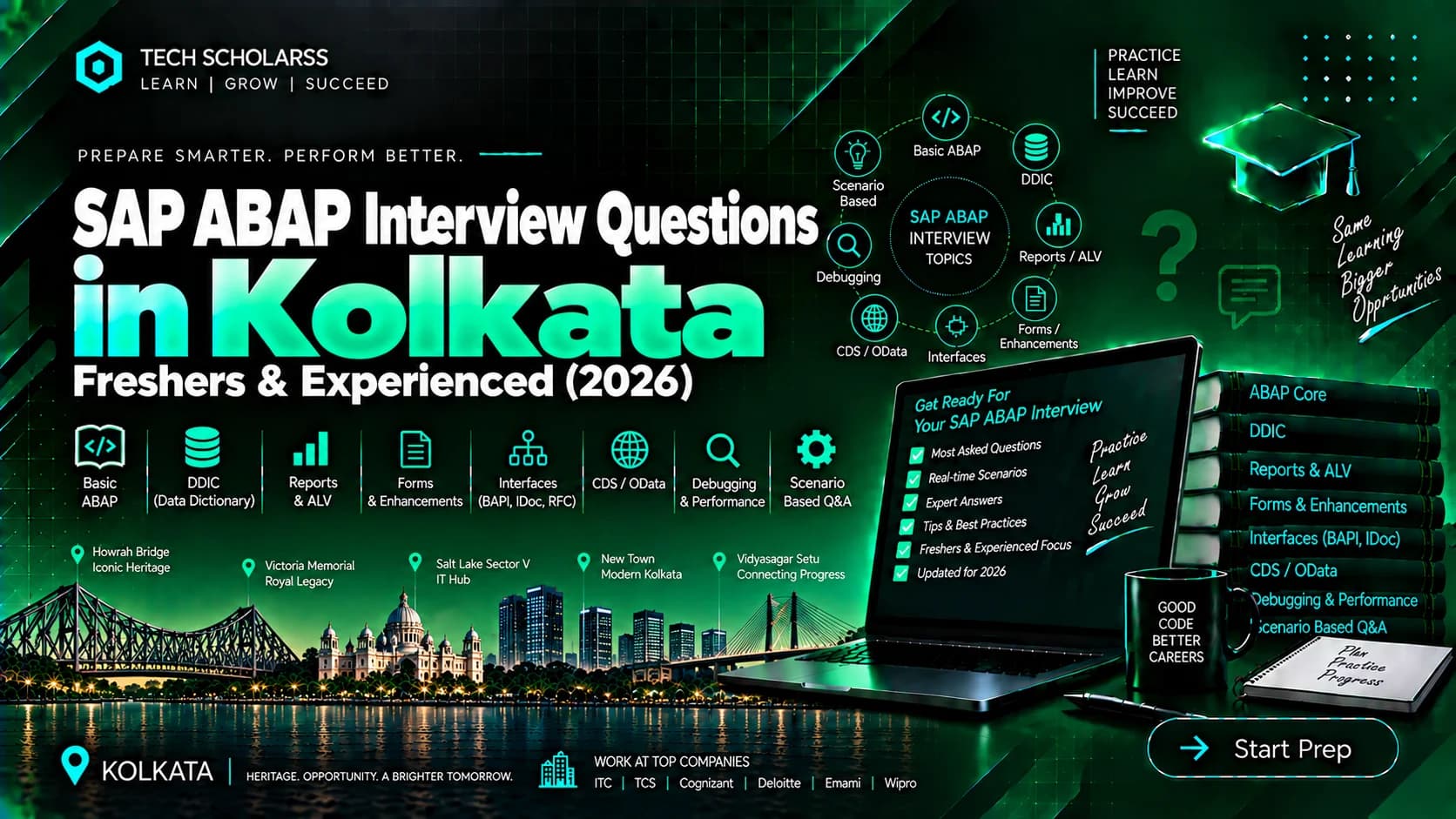
How to Actually Prepare for an SAP ABAP Interview
Most SAP ABAP interviews start simple and get progressively harder — basic syntax and DDIC concepts first, then development and coding questions, then debugging or scenario-driven discussion.
Rather than memorizing answers word for word, aim to explain what each development task does, why it exists, how it's structured, and how you'd go about debugging a common issue with it.
- •Be clear on internal table types and when to use each
- •Revisit DDIC objects and their real-world use cases
- •Practice walking through report, ALV, and form logic
- •Understand BADI, user exits, and enhancement spots
- •Revise CDS Views, AMDP, RAP, and OData basics
- •Get comfortable talking about debugging tools (SE38, ST05, SAT)
- •Prepare a clear explanation of your project work (Salt Lake Sector V, New Town, Rajarhat scenarios)
- •Practice scenario-based questions out loud
Basic SAP ABAP Interview Questions
These are usually there to check whether you actually understand the foundation, not just the syntax.
- •What is SAP ABAP?
- •What is the difference between ABAP and BASIS?
- •What is SAP NetWeaver?
- •What is the difference between ECC and S/4HANA ABAP?
- •What is a package in ABAP?
- •What is the difference between a table and a structure?
- •What is a transparent table?
- •What is the difference between a work area and an internal table?
- •What is a transport request in ABAP?
- •What is the difference between SE38 and SE80?
DDIC & Data Modeling Interview Questions
These tend to focus on Data Dictionary design and database concepts — common in Salt Lake Sector V IT services and New Town GCC hiring rounds.
- •What is the Data Dictionary (DDIC)?
- •What is the difference between a domain and a data element?
- •What are the different types of views in DDIC?
- •What is a search help and how is it used?
- •What is a lock object?
- •What is the difference between transparent, pooled, and cluster tables?
- •What is a table maintenance generator?
- •What is the difference between append and include structure?
- •What is a foreign key relationship?
- •What is the difference between a check table and a value table?
Reports, ALV & Forms Interview Questions
These focus on classical and interactive reporting, ALV, and forms — relevant for Kolkata IT services and FMCG development requirements.
- •What is the difference between classical and interactive reports?
- •What are the different events in a classical report?
- •What is a selection screen and how do you design one?
- •What is ALV and what are its types?
- •What is a field catalog in ALV?
- •What is the difference between REUSE_ALV_GRID_DISPLAY and CL_GUI_ALV_GRID?
- •What is a Smart Form and how does it differ from SAPscript?
- •What is an Adobe Form and how does it work?
- •What is a driver program in forms?
- •How do you handle pagination in forms?
ABAP Objects & Modularization Interview Questions
These focus on Object-Oriented ABAP and modularization — increasingly common at Kolkata IT services firms following modern development standards.
- •What is the difference between a class and an object?
- •What are the different visibility sections in a class?
- •What is the difference between a static and an instance method?
- •What is inheritance in ABAP Objects?
- •What is the difference between an interface and an abstract class?
- •What is polymorphism in ABAP?
- •What is the difference between a function module and a subroutine?
- •What is a function group?
- •What is the difference between RFC and BAPI?
- •How do you handle exceptions in ABAP?
Want Real Practice Before Your SAP ABAP Interview?
Build practical coding skills, real development project exposure (Salt Lake Sector V, New Town, Rajarhat), structured interview prep, and 1-to-1 code review through the main SAP ABAP program.
Explore SAP ABAP Course in Kolkata →Enhancements, BADI & User Exits Interview Questions
Enhancement questions are common at Kolkata IT services firms and FMCG companies customizing standard SAP — BADI, user exits, and enhancement spots are the highest-demand customization skills.
- •What is an enhancement?
- •What is the difference between a user exit and a BADI?
- •What is a customer exit?
- •What are enhancement spots and enhancement sections?
- •What is the difference between implicit and explicit enhancement?
- •What is a BADI implementation?
- •What is the difference between BADI and BAPI?
- •How do you find BADI for a standard transaction?
- •What is the difference between CMOD and SMOD?
- •When should you avoid using a user exit?
IDoc, RFC & Interfaces Interview Questions
Interface questions are increasingly common at Kolkata IT services firms and manufacturing IT units integrating SAP with other systems — IDoc, RFC, and OData are the highest-demand skills.
- •What is an IDoc?
- •What are the different types of IDoc?
- •What is the difference between inbound and outbound IDoc processing?
- •What is ALE and how is it configured?
- •What is the difference between RFC, tRFC, and qRFC?
- •What is a distribution model in ALE?
- •How do you monitor an IDoc?
- •What is the difference between a message type and a basic type?
- •What is the role of the partner profile in ALE?
- •How do you handle IDoc errors?
CDS, RAP & OData Interview Questions
CDS, RAP, and OData questions are increasingly common at Kolkata IT services firms migrating to S/4HANA — these modern development skills are in the highest demand.
- •What is a CDS View?
- •What is the difference between a CDS View and a DDIC View?
- •What are CDS annotations?
- •What is AMDP?
- •What is the difference between RAP and classical ABAP?
- •What is a behavior definition in RAP?
- •What is the role of a business object in RAP?
- •What is OData?
- •What is the difference between OData V2 and V4?
- •How does Fiori consume an OData service?
Debugging & Performance Interview Questions
These are meant to check whether you've actually debugged real production issues and optimized code under pressure, not just read about it.
- •What are the different types of breakpoints in ABAP?
- •What is the difference between a session breakpoint and an external breakpoint?
- •What is ST05 and how do you use it?
- •What is SAT (Runtime Analysis) and how does it help?
- •What is code inspector and ATC?
- •What are common causes of ABAP performance issues?
- •How do you optimize a SELECT statement?
- •What is the difference between FOR ALL ENTRIES and a JOIN?
- •How do you handle a dump in ABAP?
- •What is the role of the buffer in ABAP performance?
Scenario-Based SAP ABAP Interview Questions
These questions are testing your thought process on an actual development problem — often framed around Salt Lake Sector V IT services delivery, New Town GCC development standards, or Rajarhat manufacturing IT customization scenarios.
- •A report is running slow — how would you debug and optimize it?
- •A client needs a custom ALV report — how would you approach it?
- •A BADI needs to be implemented for a standard transaction — what's your process?
- •An IDoc is failing repeatedly — how would you investigate?
- •A CDS view needs to be built for analytics — what steps would you follow?
- •A RAP application needs an action button — how would you design it?
- •A Smart Form needs dynamic data — what's your approach?
- •A performance issue is reported during month-end — what's your debugging plan?
How Training Format Affects Interview Prep for Kolkata Candidates
Interview readiness has less to do with whether your classes were online or offline, and more to do with how much real coding practice, code review, mock interviews, and personal guidance you actually got.
For candidates in Kolkata, live online training can be particularly useful simply because the hours you'd otherwise spend commuting across EM Bypass or Salt Lake Sector V go straight back into coding practice. You can still join live sessions, ask questions, share your screen, and get code reviewed by a mentor without ever traveling to a fixed classroom.
Offline programs can offer solid live interaction too, but it's worth double-checking whether you're actually getting individual code review, real SAP ABAP access, and enough mock interview time.
| Prep Area | Live Online | Classroom |
|---|---|---|
| Class Format | Live, instructor-led | In-person classroom |
| Practice | Remote SAP ABAP access | Depends on the lab setup |
| Mock Interviews | Scheduled online | Usually done in person |
| Code Review | 1-to-1 support built in | Depends on the institute |
| Travel | None | Regular commute across EM Bypass, Salt Lake Sector V & Howrah Bridge |
1-to-1 Code Review Support for Interview Prep
Interview prep works a lot better when someone's actually reviewing your code and giving feedback, rather than generic tips aimed at the whole batch.
Tech Scholarss builds in dedicated 1-to-1 support specifically for this — covering individual coding doubts, project explanation practice (Salt Lake Sector V, New Town, Rajarhat scenarios), resume improvements, technical prep, debugging scenarios, and HR interview practice tuned for ITC, TCS, Cognizant, Deloitte, IBM, and Capgemini.
A mentor can also help pinpoint whether your weak spot is fundamentals, coding logic, debugging, CDS/RAP, communication, or how you explain your project — so your prep time actually goes where it's needed.
- •A personalized interview roadmap
- •Practicing your project explanation out loud
- •Resume review tailored for Kolkata SAP ABAP roles
- •Technical question rehearsal (ITC, TCS, Cognizant, Deloitte, IBM style)
- •Scenario-based coding practice
- •ABAP concept revision
- •Debugging and performance tuning prep
- •HR round guidance
SAP ABAP Interview Questions for Freshers in Kolkata
Freshers are generally expected to show solid fundamentals rather than real-world development depth. Interviewers usually lean on syntax concepts, basic DDIC tasks, simple reports, ALV, and how well you can talk through your training projects.
The key is being able to explain things in your own words and tie your answers back to actual coding practice — especially Salt Lake Sector V IT services, New Town GCC, or Rajarhat manufacturing IT scenarios.
- •What is SAP ABAP?
- •What is a transparent table?
- •What is the difference between a domain and a data element?
- •What is an internal table and what are its types?
- •What is a work area?
- •What is the difference between SELECT SINGLE and SELECT * UP TO 1 ROWS?
- •How do you write a simple report in ABAP?
- •What is ALV?
- •What is a selection screen?
- •What is a function module?
- •Talk me through one project you built during training.
SAP ABAP Interview Questions for Experienced Candidates
Experienced candidates get pulled into deeper scenario and design questions, along with real questions about their actual project responsibilities, code review experience, and how they handled debugging or client communication — often framed around Kolkata IT services, manufacturing IT, or FMCG contexts.
- •Walk me through your SAP ABAP development experience.
- •Which SAP modules have you worked with?
- •Describe a performance tuning scenario you handled.
- •Tell me about a tough debugging issue you resolved in production.
- •How did you handle a failing IDoc in production?
- •Describe a BADI implementation you did from scratch.
- •How did you approach a CDS view or RAP project?
- •How did you handle code review and testing for transport workflow?
- •How did you explain a technical issue to a functional consultant or client?
Common Interview Mistakes to Avoid
Knowing the syllabus doesn't automatically mean you'll interview well — a lot of candidates stumble because their answers stay too theoretical.
- •Reciting memorized syntax without practical context
- •Not being solid on DDIC and internal table fundamentals
- •Not knowing CDS, RAP, and OData well
- •Skipping debugging and performance tuning concepts
- •Struggling to explain your own training projects (Salt Lake Sector V, New Town, Rajarhat)
- •Not practicing scenario-based questions beforehand
- •Mixing up development knowledge with actual debugging knowledge
- •Being unable to explain why a code pattern exists, not just what it does
- •Giving vague answers due to insufficient practice
Frequently Asked Questions
QWhat are the most frequently asked SAP ABAP interview questions?+
Expect questions on ABAP syntax, DDIC, internal tables, reports, ALV, forms, ABAP Objects, BADI, user exits, IDoc, CDS Views, RAP, OData, debugging, and scenario-based coding problems.
QDo freshers and experienced candidates get asked different questions?+
Yes — freshers are usually tested more on fundamentals and simple reports/ALV, while experienced candidates face deeper design, CDS, RAP, OData, and enhancement-focused questions.
QWhat kind of questions come up in the debugging round?+
Typically performance issues, dump analysis, failing jobs, IDoc errors, and SQL optimization scenarios.
QWhat kind of questions come up in the S/4HANA ABAP round?+
Usually CDS Views, AMDP, RAP business objects, OData services, Fiori integration, and code pushdown concepts.
QWhy do debugging and performance questions matter so much?+
Because they reveal whether you actually understand how ABAP runs in a live production system, not just how to write a report — critical for Kolkata IT services (ITC, TCS, Cognizant) and GCC (Deloitte, IBM) roles.
QHow should freshers in Kolkata prepare for these interviews?+
Focus on ABAP syntax, DDIC, internal tables, basic reports, ALV, real project work (Salt Lake Sector V, New Town, Rajarhat scenarios), function modules, debugging basics, resume quality, and mock interview practice.
QDoes Tech Scholarss offer one-on-one interview coaching?+
Yes — dedicated 1-to-1 mentoring covers code review, project explanation, technical prep, resume work, scenario-based practice, and HR round preparation tuned for ITC, TCS, Cognizant, Deloitte, IBM, and Capgemini hiring patterns.
QDoes online SAP ABAP training actually help with interview prep?+
Yes, as long as it's genuinely live and includes real SAP ABAP access, development project work, mock interviews, code review, and individual feedback.
QWhat kind of scenario-based questions should I expect?+
Common ones involve performance tuning, transport failures, job failures, IDoc issues, CDS/RAP design problems, BADI implementation, and debugging — often framed around Salt Lake Sector V, New Town, or Rajarhat contexts.
QAre SAP ABAP interviews at IT services different from FMCG interviews?+
Somewhat — IT services interviews (ITC, TCS, Cognizant, Deloitte style) often focus more on enhancement workflow, interface design, and client delivery processes, while FMCG / manufacturing IT interviews (Emami, Wipro style) tend to focus more on reports, forms, and production support scenarios.
Written by Tech Scholarss Team
SAP ABAP training specialists with 8+ years of experience in enterprise ERP training. We help learners across India — including Salt Lake Sector V, New Town, Rajarhat, Howrah, EM Bypass, Park Street, BBD Bagh, Behala, and other Kolkata areas — build practical SAP ABAP development skills with live S/4HANA training, real coding projects, and 1-to-1 code review support.