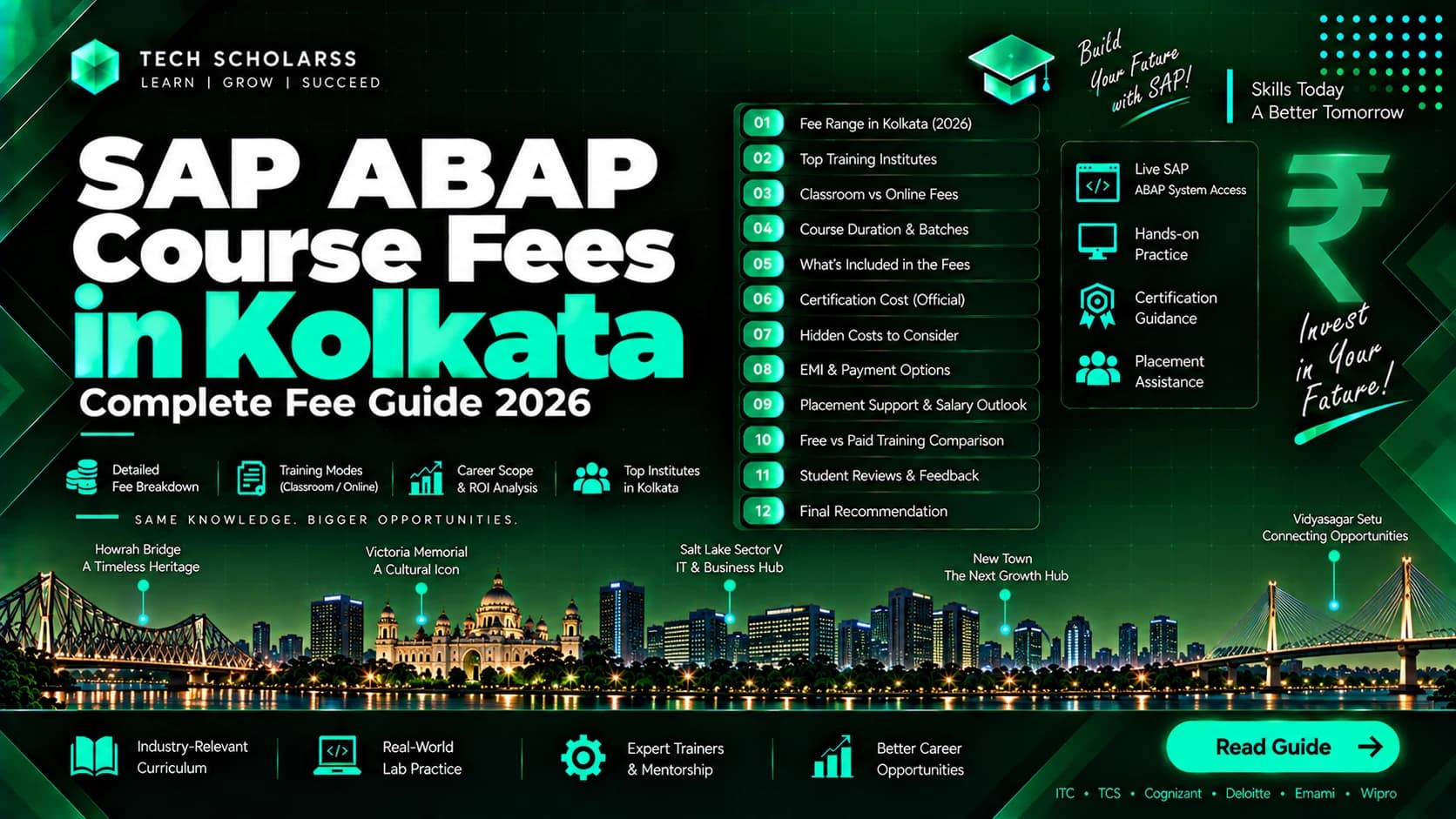
SAP ABAP Course Fees in Kolkata
Ask a few institutes in Kolkata for their SAP ABAP fee and you'll likely get a range of answers — because the courses behind those numbers aren't the same. A short, surface-level intro to ABAP syntax costs less because it covers less: it doesn't walk through Data Dictionary (DDIC), internal tables, classical reports, ALV, Smart Forms, Adobe Forms, enhancements, BADI, IDoc interfaces, CDS Views, RAP, OData, or structured live coding projects.
A lower fee isn't automatically a bad deal, and a higher one isn't automatically better — the real question is whether the hours you're paying for convert into genuine coding practice, real system access, trainer code review, and post-course career guidance for Kolkata's IT services, manufacturing IT, and FMCG job market.
| Training Type | Typical Length | What's Usually Covered |
|---|---|---|
| Quick Overview | 2–3 weeks | ABAP syntax, basic reports only |
| Standard Track | 1–2 months | ABAP core topics with supervised coding practice |
| Full Curriculum | 3 months | DDIC + Reports + ALV + Forms + Enhancements + CDS + RAP + real projects |
| Mentor-Backed Career Track | 3 months | Everything above + 1-to-1 code review, resume building, interview drills |
Actual fee figures vary by institute, trainer background, and what's bundled. Contact Tech Scholarss directly for current fee details specific to Kolkata learners.
What Should Actually Be Inside the Fee?
Two courses priced almost the same can deliver wildly different value — one might give you real SAP ABAP development access and a trainer reviewing your code live, while the other relies on recorded lectures and static screenshots. Before you commit, verify what's genuinely included in the price.
- •Live, instructor-led coding sessions (not just recordings)
- •Real SAP GUI / Eclipse ADT / S/4HANA development access
- •Assignments tied to each module with code review
- •Hands-on development projects (reports, ALV, forms, CDS, RAP)
- •Reference notes, code templates, and reusable snippets
- •A certificate on completion
- •Help building your resume for Kolkata IT services roles
- •Mock interview rounds with real ABAP scenario questions
- •Ongoing career guidance
- •A channel for resolving code doubts
- •A dedicated 1-to-1 mentor for code review
- •Salt Lake Sector V IT services, New Town GCC & Rajarhat manufacturing IT system scenarios
What Actually Moves the Fee Up or Down?
Instead of chasing the lowest number on the market, it's worth understanding what causes the variation — that way you can judge whether a particular fee is justified for a Kolkata learner.
- •How deep and long the curriculum is
- •Whether live SAP GUI / Eclipse ADT / S/4HANA ABAP access is part of the deal
- •How many real development projects you'll actually code
- •The trainer's background and hands-on ABAP development experience
- •Class size — smaller batches mean more individual code review
- •How code doubts get resolved (and how fast)
- •Whether career and interview coaching is included
- •Certification and the quality of study material
- •Presence of dedicated 1-to-1 code review
- •Coverage of Kolkata-specific enterprise scenarios (Salt Lake Sector V IT services development, New Town GCC ABAP projects, Rajarhat manufacturing IT customization)
Classroom Training vs Live Online Training in Kolkata
For someone based in Kolkata, choosing between a physical classroom and live online classes often comes down to how you want to spend your time. A classroom gives you in-person contact with the trainer, but it also means commuting on a fixed schedule — and in Kolkata, EM Bypass traffic, Salt Lake Sector V congestion, or Howrah Bridge rush can easily eat up 2–3 hours a day depending on where you live and where the institute is.
Live online training removes that commute. You log in from wherever suits you — home in Behala, office in Salt Lake Sector V, or a co-working space in New Town — ask questions in real time, share your screen when you're stuck on a CDS view or RAP issue, and still get remote access to the SAP ABAP system for hands-on coding practice.
What matters more than the online-vs-offline label is whether the online course is genuinely live. Pre-recorded videos aren't the same as an instructor writing and debugging live code in real time — a proper online program still delivers live teaching, real coding practice, doubt support, projects, and career guidance.
| What Matters | Live Online | Physical Classroom |
|---|---|---|
| Commute | None — attend from anywhere in Kolkata & West Bengal | Regular travel across EM Bypass, Salt Lake Sector V & Howrah Bridge |
| Interaction with Trainer | Live, real-time | Face-to-face |
| Hands-on ABAP Practice | Remote access to SAP GUI / Eclipse ADT / S/4HANA | Depends on the institute's lab setup |
| Fits Around IT Shifts | Easier to schedule around | Usually tied to fixed classroom timings |
| 1-to-1 Code Review | Can be built in as 1-to-1 support | Varies by trainer/institute |
| Time Saved | Extra time for coding practice instead of EM Bypass commute | Travel time eats into your day |
Why Having a Dedicated Code Reviewer Actually Matters
No two learners get stuck on the same thing. One person might struggle with internal table optimization, another might breeze through classical reports but trip on RAP behavior definitions, and someone else might understand everything but freeze up during a debugging scenario.
That's exactly the gap 1-to-1 code review fills. The group class covers the syllabus at the same pace for everyone — a mentor can slow down, review your code line by line, and focus on wherever you personally are stuck.
At Tech Scholarss, this code review runs alongside the regular live classes, not instead of them — so Kolkata learners get the structured curriculum plus someone checking their code quality, project direction, resume work, and interview readiness.
- •A learning plan built around your coding pace
- •One-on-one doubt clearing on ABAP tasks
- •Code review sessions with real feedback
- •Direction on projects and assignments
- •Help planning what to code, debug, and revise
- •Resume feedback tailored for SAP ABAP roles in Kolkata
- •Technical interview rehearsal (ITC, TCS, Cognizant, Deloitte, IBM style)
- •HR round preparation
- •Broader career-path guidance
Exploring SAP ABAP Training Options in Kolkata?
Check out the full 12-module curriculum, live SAP development practice, real coding project work, batch timings, and 1-to-1 code review designed for Kolkata learners.
Explore SAP ABAP Course in Kolkata →Should You Go for a Crash Course or the Full Program?
A short SAP ABAP course can work fine if you already have a programming background and just need an ABAP refresher. If you're starting from scratch, a few weeks usually isn't enough to properly absorb ABAP syntax, DDIC, internal tables, reports, ALV, forms, enhancements, CDS, RAP, and how real ABAP projects actually flow.
A longer, full-length program gives you room to write real ABAP code, make mistakes and fix them, complete real development projects, revisit tricky topics, and get properly interview-ready.
It's also worth confirming the course covers S/4HANA ABAP rather than relying only on outdated ECC screenshots and theory slides — especially for Kolkata learners targeting modern developer roles in Salt Lake Sector V IT services delivery, New Town GCC ABAP development, and Rajarhat manufacturing IT customization.
How Long Does the SAP ABAP Course Actually Take?
Covering ABAP fundamentals, DDIC, internal tables, reports, ALV, Smart Forms, Adobe Forms, modularization, ABAP Objects, BADI, user exits, IDoc, CDS Views, AMDP, RAP, OData, debugging, and interview prep properly takes time when it's taught in a logical sequence rather than rushed through.
Tech Scholarss runs this as a 3-month program, moving learners from ABAP syntax fundamentals through DDIC, reports, ALV, forms, enhancements, CDS, RAP, real project work, and finally career prep.
The exact pace can shift depending on your prior programming exposure, how much time you put into coding practice outside class, and your own learning speed — particularly for working professionals in Kolkata juggling Salt Lake Sector V IT or New Town GCC shifts alongside training.
What Does the SAP ABAP Syllabus Actually Cover?
A properly built SAP ABAP syllabus needs to weave together ABAP fundamentals, DDIC, internal tables, reports, ALV, forms, enhancements, BADI, IDoc, ABAP Objects, CDS, RAP, OData, and enough project work to make it stick.
Here's how the Tech Scholarss curriculum is broken down across 12 modules:
- •Module 1 – ABAP Fundamentals & NetWeaver Basics (Kolkata IT Services Context)
- •Module 2 – Data Dictionary (DDIC) & Database Tables
- •Module 3 – ABAP Reports & Internal Tables
- •Module 4 – ALV Reports & Interactive Reporting
- •Module 5 – Forms, Smart Forms & Adobe Forms
- •Module 6 – Modularization, Function Modules & Subroutines
- •Module 7 – ABAP Objects (OOP) & Exception Handling
- •Module 8 – Enhancements, BADI & User Exits
- •Module 9 – IDoc, ALE & Interfaces
- •Module 10 – CDS Views, AMDP & S/4HANA Programming
- •Module 11 – RESTful ABAP Programming (RAP) & OData
- •Module 12 – S/4HANA ABAP, Performance Tuning & Placement Prep (Kolkata Hiring)
For a topic-by-topic breakdown, check the full curriculum on the main SAP ABAP Course in Kolkata page. View curriculum →
Who Is This Course Actually For?
SAP ABAP tends to click fastest for people already comfortable with programming logic — but you don't need any prior SAP exposure to get started.
That covers B.Tech/BE/M.Tech, MCA, BCA, and B.Sc IT graduates, working Java/.NET/C++ developers, IT support engineers, QA engineers, SAP functional consultants looking to add development skills, and working professionals in Kolkata looking to pivot into SAP.
People from non-programming backgrounds can pick it up too, as long as the program builds in programming logic fundamentals before jumping into ABAP-specific concepts.
What Kind of Roles Can This Lead To?
SAP ABAP skills open doors across ABAP developer roles, technical consultant positions, S/4HANA developer teams, RAP/CDS specialist paths, and technical lead roles — and Kolkata learners have strong access to the region's IT services and manufacturing IT job market.
Typical job titles include SAP ABAP Developer, SAP ABAP Technical Consultant, SAP S/4HANA Developer, SAP RAP / CDS Specialist, SAP Interface Developer, and SAP ABAP Technical Lead.
One real advantage of learning through live online classes from Kolkata is that your job search isn't boxed into the city — SAP ABAP roles are spread across West Bengal and India, and many come with remote or hybrid options.
What Does SAP ABAP Pay Look Like in Kolkata?
Pay depends heavily on who's hiring, your experience level, the exact role, real development project exposure, and how well you communicate — a certificate alone won't fix a low offer.
As a rough starting point, freshers often land somewhere around ₹4–6.5 LPA, and that figure climbs meaningfully once you've got real coding work behind you. Salt Lake Sector V IT services and New Town GCC roles often sit at the higher end.
Treat these as loose indicators, not promises — actual offers swing a lot based on the company, city, experience level, and interview performance.
How to Actually Pick an SAP ABAP Institute in Kolkata
Before signing up anywhere in Kolkata, put the advertised fee aside for a moment and focus on what the day-to-day learning experience will actually look like.
A few direct questions usually cut through the marketing quickly:
- •Are the classes actually live, or mostly pre-recorded?
- •Do I get real hands-on access to SAP GUI / Eclipse ADT / S/4HANA?
- •How many real development projects are built into the course?
- •Does the trainer explain the coding logic, not just the syntax?
- •Is CDS, RAP, and OData development actually taught?
- •How fast do code doubts get resolved?
- •Is 1-to-1 code review genuinely included?
- •What does 'career guidance' actually consist of?
- •Is resume and interview prep part of the package?
- •Can I sit in on a demo class first?
Questions Worth Asking Before You Pay
A short checklist here can save Kolkata learners from awkward surprises a month into the course.
- •What's the total fee, all-inclusive?
- •Are there hidden or extra charges later?
- •Is SAP ABAP development access part of the fee, or separate?
- •How many live projects are actually included?
- •Does the fee include certification?
- •Is EMI or installment payment an option?
- •What's the refund policy if I need to drop out?
- •Are there batch timings that fit around a Salt Lake Sector V IT or New Town GCC shift in Kolkata?
- •Is the whole course live, or partly recorded?
- •How exactly does the 1-to-1 code review work in practice?
Frequently Asked Questions
QWhat does an SAP ABAP course cost in Kolkata?+
It varies based on course length, whether live SAP ABAP access is included, project count, trainer background, certification, and code review sessions — reach out to Tech Scholarss for current pricing specific to Kolkata learners.
QCan I learn SAP ABAP online while based in Kolkata?+
Yes — Tech Scholarss runs fully live online SAP ABAP batches with real instructor interaction, hands-on SAP GUI / Eclipse ADT practice, development project work, and mentor support for Salt Lake Sector V, New Town, Rajarhat, and other Kolkata learners.
QIs online training as good as sitting in a physical classroom in Kolkata?+
For most learners in Kolkata, live online training works just as well or better, mainly because it removes the daily commute across EM Bypass, Salt Lake Sector V, or Howrah Bridge while keeping real-time interaction with the trainer. What really counts is teaching quality, live coding practice, and system access — not the format label.
QDoes Tech Scholarss offer one-on-one code review for Kolkata students?+
Yes — alongside the group classes, you get dedicated 1-to-1 mentor support for coding doubts, project code review, resume work, and interview prep tuned for ITC, TCS, Cognizant, Deloitte, IBM, and Capgemini-style hiring.
QHow long does the full SAP ABAP course take?+
The complete program is structured as a 3-month journey covering all 12 modules, hands-on coding practice, projects, and placement preparation.
QWhat all is bundled into the training?+
Live coding classes, real SAP ABAP development practice, module assignments with code review, development project work, certification, interview prep, career guidance, and personal mentoring.
QWho is this course suitable for in Kolkata?+
B.Tech/BE/M.Tech, MCA, BCA, B.Sc IT graduates, working Java/.NET/C++ developers, IT support engineers, QA engineers, SAP functional consultants, and career-switchers — especially those in Salt Lake Sector V IT services delivery, New Town GCC ABAP development, and Rajarhat manufacturing IT customization.
QAre there real projects, or is it mostly theory?+
The course includes practical development work covering reports, ALV, forms, enhancements, BADI, IDoc, CDS Views, RAP, and OData — modeled on Salt Lake Sector V IT services, New Town GCC, and Rajarhat manufacturing IT scenarios.
QWhat salary can a fresher realistically expect?+
It varies by employer, experience, and skill level, but a broad starting range for freshers is roughly ₹4–6.5 LPA — actual offers can differ significantly and nothing here is guaranteed.
QIs this course too advanced for a complete fresher?+
Not at all — freshers do fine as long as the course builds up programming logic, DDIC, and ABAP fundamentals alongside the development-specific training, real coding practice, and interview prep.
Written by Tech Scholarss Team
SAP ABAP training specialists with 8+ years of experience in enterprise ERP training. We help learners across India — including Salt Lake Sector V, New Town, Rajarhat, Howrah, EM Bypass, Park Street, BBD Bagh, Behala, and other Kolkata areas — build practical SAP ABAP development skills with live S/4HANA training, real coding projects, and 1-to-1 code review support.