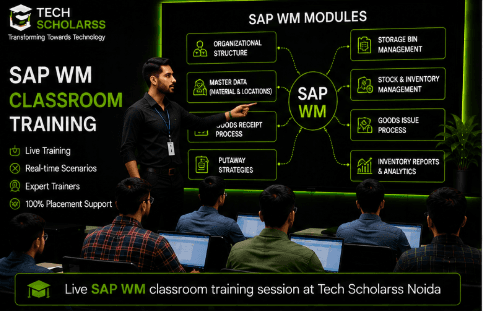
What Is SAP WM?
SAP WM (Warehouse Management) is the module within SAP ERP that manages the physical warehouse — how stock is organized, moved, and tracked using storage types, bins, and transfer orders.
WM covers classic configuration (warehouse structure, master data, goods movement, storage strategies) as well as modern extensions (RF/barcode operations, Fiori apps, and the direction toward SAP EWM for complex warehouses). Together, these form the technical backbone that keeps physical stock accurate and traceable.
SAP WM Course Syllabus
A complete, job-focused SAP WM syllabus is typically organized into the following 12 modules:
- •Module 1 – Introduction to SAP & ERP: SAP overview, ERP concepts, navigation, organizational structure
- •Module 2 – Warehouse Structure Setup: Warehouse number, storage type, storage section, storage bin
- •Module 3 – Master Data for WM: Material master warehouse views, storage type data, quant data, batch basics
- •Module 4 – Goods Receipt Process: Inbound delivery, putaway strategy, transfer requirement, transfer order creation
- •Module 5 – Goods Issue Process: Outbound delivery, picking strategy, wave management, transfer order for GI
- •Module 6 – Storage & Movement Strategies: Putaway/picking strategies, stock removal, two-step picking
- •Module 7 – Internal Warehouse Movements: Stock transfer, replenishment, posting changes, physical inventory
- •Module 8 – Integration with MM & SD: WM-MM integration, WM-SD integration, delivery processing
- •Module 9 – Batch & Serial Number Management: Batch determination, serial number profile, batch split
- •Module 10 – RF & Barcode Concepts: RF framework basics, RF menu configuration, barcode scanning flow
- •Module 11 – Introduction to EWM Concepts: Classic WM vs EWM, EWM structure, S/4 HANA Fiori apps for warehouse
- •Module 12 – Projects & Placement Preparation: 7 live configuration projects, resume and interview prep
This module structure mirrors the curriculum followed on the main course page. View curriculum →
Warehouse Structure Setup
Warehouse structure setup is one of the most fundamental WM activities — defining the warehouse number, storage types, storage sections, and storage bins that everything else is built on. A good syllabus spends significant time here since structure setup is where most new WM consultants get their first real hands-on exposure in a live environment.
Goods Receipt & Goods Issue
Goods receipt and goods issue govern how stock physically enters and leaves the warehouse — configuring putaway strategies for inbound deliveries and picking strategies with wave management for outbound deliveries. This is tested frequently in interviews since it requires understanding both the technical configuration and the operational flow that surrounds it.
SAP WM & S/4 HANA / EWM Integration
Modern WM work is increasingly built around Fiori-based apps and an awareness of how classic WM connects to SAP EWM rather than classic-screen configuration alone — understanding how they connect is often what separates a strong candidate from an average one.
- •WM + MM/SD Integration: Automatic transfer order creation triggered by goods movements in MM and SD
- •WM + RF/Barcode: Execute putaway and picking through mobile, barcode-driven transactions
- •WM + EWM Direction: Understand how classic WM concepts map onto SAP EWM's warehouse structure
Want the Full SAP WM Curriculum?
See the detailed module-wise curriculum, live project list, and batch timings on our main course page.
Explore SAP WM Course in Noida →Practical SAP WM Projects
Modules alone don't prepare you for interviews — real configuration projects do. A good SAP WM program includes hands-on project work such as building a warehouse structure from scratch, configuring inbound and outbound processes, and setting up stock transfer and replenishment.
The most valuable projects are the ones that combine a physical inventory cycle with a simulated RF/barcode transaction, since that's where most real-world implementation work — and most interview questions — actually happen.
SAP WM Course Duration
Covering all 12 modules properly, along with hands-on configuration practice and project work, typically takes 5–6 months when taught progressively. Shorter crash courses exist but usually compress or skip the RF/barcode and EWM-introduction modules, which limits how job-ready you are at the end.
Who Should Learn SAP WM?
This syllabus works well for B.Com, BBA, Supply Chain, and Mechanical/Industrial Engineering graduates, since the module structure closely follows logistics and operations concepts they've already studied. Working professionals moving from manual warehouse tracking or MM/SD consulting, and support engineers looking to move into SAP consulting, also fit well into this curriculum.
If you're from a non-technical background, look for a course that spends time on core warehousing and inventory fundamentals in Module 1–2 before moving deeper into SAP-specific configuration.
SAP WM Career Opportunities
This syllabus maps directly to roles such as SAP WM Consultant, SAP Support Consultant, SAP Implementation Consultant, and SAP Cloud/EWM Consultant. Demand for these roles comes largely from IT consulting firms, SAP implementation partners, and logistics majors running warehouse configuration projects.
See the full career breakdown here: View curriculum →
How to Choose an SAP WM Course
When comparing syllabuses across institutes, it's worth checking a few things directly:
- •Does the syllabus include RF/barcode configuration in depth?
- •Is EWM direction covered, or only theory?
- •How many real configuration projects are included in Module 12?
- •Is training delivered on S/4HANA, or only the older ECC-style environment?
- •Are trainers implementation-qualified, not just SAP-technical trainers?
Frequently Asked Questions
What is included in the SAP WM syllabus?+
The syllabus covers 12 modules — SAP & ERP basics, warehouse structure setup, master data, goods receipt/issue, storage strategies, internal movements, integration with MM/SD, batch/serial management, RF concepts, EWM introduction, and a final projects module.
How long does it take to complete the SAP WM syllabus?+
A complete, progressively taught program covering all 12 modules with hands-on practice typically takes 5–6 months.
Does the syllabus include integration with other SAP modules?+
Yes, Module 8 covers WM integration with MM and SD, including delivery processing and automatic transfer order creation.
Is EWM covered in the syllabus?+
Yes, Module 11 covers classic WM vs EWM concepts, EWM warehouse structure, and S/4 HANA Fiori apps for warehouse.
Are real projects included in the syllabus?+
Yes, Module 12 includes 7 live configuration projects along with resume and interview preparation.
Is this syllabus suitable for non-logistics graduates?+
Yes, as long as the course covers core warehousing and inventory fundamentals early on before moving into SAP-specific configuration.
Where can I check the SAP WM course fees?+
See the detailed SAP WM course fees guide for what's typically included in the fee across different program types.