Introduction
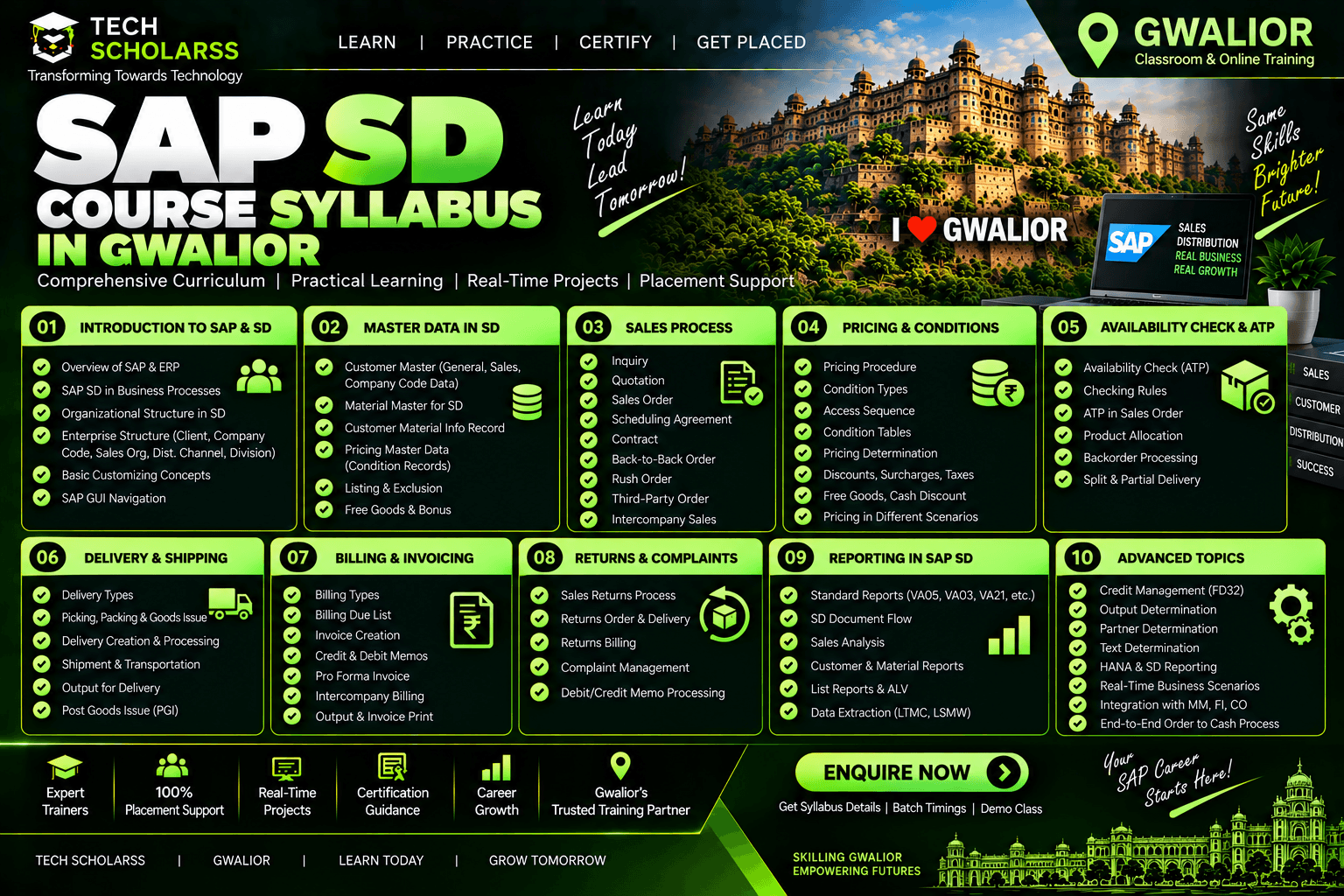
SAP SD is built around the sales and distribution cycle. A complete curriculum should explain how customer requirements become quotations, sales orders, deliveries, goods issues and billing documents. This Gwalior-focused guide explains the SAP SD syllabus module by module and shows how the topics connect into an end-to-end order-to-cash process.
Complete SAP SD Syllabus in Gwalior
The SAP SD curriculum should move progressively from SAP fundamentals into sales documents, pricing, delivery, shipping, billing and integration.
The Tech Scholarss Gwalior program is organized across 12 modules so that learners first understand the sales process and then practice related activities inside SAP.
The syllabus also includes practical projects, interview preparation and dedicated 1-to-1 mentor support.
| Module | Main Area |
|---|---|
| Module 1 | Introduction to SAP & ERP |
| Module 2 | SAP SD Organizational Structure |
| Module 3 | Customer, Material & Sales Master Data |
| Module 4 | Inquiry & Quotation |
| Module 5 | Sales Order Management |
| Module 6 | Pricing & Conditions |
| Module 7 | Availability & Delivery |
| Module 8 | Shipping & Goods Issue |
| Module 9 | Billing & Output |
| Module 10 | Advanced Sales Processes |
| Module 11 | Integration with FI, MM & Other Processes |
| Module 12 | Projects & Placement Preparation |
Module 1 – Introduction to SAP & ERP
The first module establishes the foundation needed to understand SAP SD inside an enterprise ERP environment.
Students learn the SAP interface, navigation concepts and how sales processes connect with other business functions.
- •What is ERP?
- •SAP overview
- •SAP navigation
- •Basic SAP terminology
- •SAP S/4HANA basics
- •Business process overview
- •Functional SAP modules
Module 2 – SAP SD Organizational Structure
The organizational structure determines how sales and distribution activities are represented inside SAP.
Learners study the organizational units that support sales operations and understand how they are connected.
- •Sales Organization
- •Distribution Channel
- •Division
- •Sales Area
- •Plant
- •Shipping Point
- •Organizational assignments
Module 3 – Customer, Material & Sales Master Data
Master data is a major foundation of SAP SD because sales documents depend on customer, material and sales-area information.
The module explains how master data supports order processing, pricing, delivery and billing.
- •Customer / Business Partner basics
- •Material Master
- •Customer sales-area data
- •Partner functions
- •Material sales data
- •Customer-material information
- •Master-data relationships
Want the Complete SAP SD Learning Roadmap?
Explore the full Gwalior SAP SD course with 12 modules, practical projects, live SAP practice and dedicated 1-to-1 mentor guidance.
Explore SAP SD Course in Gwalior →Module 4 – Inquiry & Quotation
Sales processes can begin with customer inquiries and quotations before an actual sales order is created.
Learners understand the purpose and sequence of these pre-sales documents.
- •Customer inquiry
- •Quotation
- •Document flow
- •Validity periods
- •Reference documents
- •Pre-sales processing
- •Quotation-to-order relationship
Module 5 – Sales Order Management
Sales orders form the central transaction in many order-to-cash scenarios. This module explains how customer requirements are converted into sales documents.
Learners practice common order-processing concepts and understand how sales orders interact with later delivery and billing stages.
- •Sales order creation
- •Order types
- •Item categories
- •Schedule lines
- •Partner determination
- •Document flow
- •Order changes
Module 6 – Pricing & Conditions
Pricing determines how the system calculates the commercial value of a sales document.
Students learn pricing concepts and how conditions influence the final sales value.
- •Condition techniques
- •Condition types
- •Access sequences
- •Pricing procedures
- •Discounts
- •Freight conditions
- •Taxes
- •Condition records
Module 7 – Availability & Delivery
After a sales order is created, the organization needs to determine whether and when the requested material can be delivered.
This module introduces availability concepts and delivery processing.
- •Availability check
- •Delivery basics
- •Delivery types
- •Delivery creation
- •Picking overview
- •Packing overview
- •Delivery document flow
Module 8 – Shipping & Goods Issue
Shipping processes prepare materials for dispatch and update the relevant SAP process stages.
Learners understand picking, packing, goods issue and shipping-related process flow.
- •Shipping process
- •Picking
- •Packing
- •Handling units overview
- •Post Goods Issue
- •Route-related concepts
- •Shipping documentation
Module 9 – Billing & Output
Billing is the stage where the sales transaction is converted into a billing document used for customer invoicing.
The module explains billing types, document flow and the relationship between billing and financial accounting.
- •Billing basics
- •Billing types
- •Invoice creation
- •Credit memo
- •Debit memo
- •Cancellation
- •Output concepts
- •Billing document flow
Module 10 – Advanced Sales Processes
Real business environments use different sales scenarios beyond standard order processing.
These topics help learners understand common advanced processes and prepare for scenario-based interviews.
- •Third-party sales overview
- •Returns process
- •Free-of-charge processes
- •Credit management concepts
- •Intercompany sales overview
- •Special sales scenarios
- •Document-flow analysis
Module 11 – Integration with FI, MM & Other Processes
SAP SD works closely with financial accounting and other SAP processes. Sales, delivery and billing activities can create downstream financial and material effects.
Learners study these connections to understand the complete business process rather than isolated sales transactions.
- •SD-FI integration
- •SD-MM touchpoints
- •Billing accounting impact
- •Goods issue relationship
- •Revenue posting concepts
- •Order-to-cash integration
- •End-to-end business flow
Module 12 – Projects & Placement Preparation
The final module connects the earlier topics into practical order-to-cash projects and job preparation.
Learners work through sales scenarios while preparing project explanations, resumes and interview responses.
- •7 practical SAP SD projects
- •End-to-end order-to-cash scenario
- •Portfolio setup
- •Resume preparation
- •Technical mock interviews
- •HR round preparation
Online vs Offline SAP SD Training in Gwalior
Live online SAP SD training can be practical for Gwalior learners because it removes daily classroom travel while still allowing live interaction and SAP system practice.
Students should check that online training genuinely includes live instruction, SAP access, projects, doubt support and individual guidance.
Offline training can also be effective when the institute provides strong trainers, practical labs and individual project support.
| Area | Live Online | Offline |
|---|---|---|
| Interaction | Live instructor interaction | Live classroom interaction |
| SAP Practice | Remote SAP system practice | Depends on lab availability |
| Travel | No daily commute | Regular classroom travel |
| Flexibility | Morning/evening/weekend options | Usually fixed timings |
| Mentoring | 1-to-1 support can be scheduled | Depends on institute |
1-to-1 Mentor Support During SAP SD Training
A structured syllabus tells a learner what to study, but individual guidance can help determine which topics need more practice.
Tech Scholarss provides dedicated 1-to-1 mentor guidance for SAP SD doubts, learning plans, projects, resume preparation and interview readiness.
Mentor support can also help learners connect individual topics such as pricing, delivery, billing and integration into one complete order-to-cash process.
- •Individual learning roadmap
- •Doubt support
- •Project review
- •Sales-process explanation
- •Pricing and billing revision
- •Resume guidance
- •Technical interview practice
- •HR preparation
Skills You Can Build Through SAP SD Training
A practical SAP SD program should help learners build both SAP knowledge and sales-process understanding.
The goal is to become comfortable explaining why each document exists, how the process moves forward and where it integrates with other SAP functions.
- •Sales-process understanding
- •Enterprise structure knowledge
- •Customer master knowledge
- •Material sales-data understanding
- •Sales-order processing
- •Pricing concepts
- •Delivery processing
- •Shipping and goods issue
- •Billing
- •SD-FI integration
- •Order-to-cash understanding
- •Scenario-based problem solving
- •Project explanation
- •Interview communication
Frequently Asked Questions
What is included in the SAP SD syllabus?+
The syllabus covers SAP basics, organizational structure, customer and material master data, inquiry, quotation, sales orders, pricing, delivery, shipping, billing, advanced sales processes, integration and practical projects.
How many modules are covered in this SAP SD course?+
The structured Gwalior SAP SD program is organized into 12 progressive modules.
Does the SAP SD syllabus include pricing?+
Yes. Pricing and condition techniques are covered as an important part of the SAP SD curriculum.
Does the syllabus include delivery and billing?+
Yes. Delivery, shipping, goods issue, billing and related document-flow concepts are included.
Does SAP SD syllabus include FI integration?+
Yes. SD-FI integration and the accounting impact of billing are covered in the integration module.
Does Tech Scholarss provide 1-to-1 mentor support?+
Yes. Dedicated 1-to-1 mentor guidance is provided for individual doubts, projects, resumes and interview preparation.
Is online SAP SD training useful for Gwalior students?+
Live online training can be effective when it provides instructor interaction, practical SAP access, projects, doubt support and individual guidance.
Written by Tech Scholarss Team
SAP trainers with hands-on implementation and corporate training experience. Last updated 7 September 2026.