What Is SAP QM?
SAP QM stands for Quality Management — the SAP module that manages quality planning, inspection, and control across procurement, production, and sales processes inside an organization.
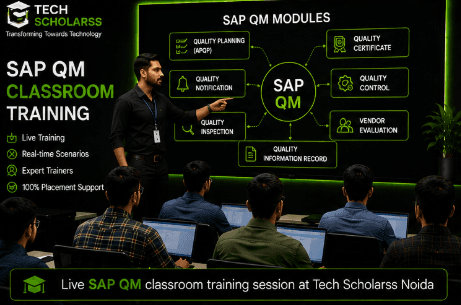
QM covers quality planning (inspection plans, master inspection characteristics), quality inspection (inspection lots, results recording, usage decisions), and quality control (notifications, certificates), and integrates closely with Materials Management (MM), Production Planning (PP), and Sales & Distribution (SD).
SAP QM Course Syllabus
A complete, job-focused SAP QM syllabus is typically organized into the following 12 modules:
- •Module 1 – Introduction to SAP & ERP: SAP overview, ERP concepts, organizational structure, S/4 HANA basics
- •Module 2 – Master Data (Material QM View & Inspection Plans): Material master QM view, inspection plan creation, master inspection characteristics
- •Module 3 – Quality Info Records & Vendor Evaluation: QM in procurement basics, source inspection setup
- •Module 4 – Inspection Types & Inspection Lot Origins: Configuring inspection types for goods receipt, in-process, and final inspection
- •Module 5 – Inspection Processing: Inspection lot creation, sample determination, results recording
- •Module 6 – Usage Decision & Stock Posting: Usage decision codes, follow-up actions, stock posting after inspection
- •Module 7 – Quality Notifications: Defect recording, notification types, CAPA (corrective and preventive action)
- •Module 8 – Quality Certificates: Certificate profiles, certificate creation and printing
- •Module 9 – QM in Procurement & Sales: Source inspection, delivery inspection, customer complaints
- •Module 10 – Integration with MM, PP & SD: Goods receipt inspection, in-process inspection, sales-return inspection
- •Module 11 – Projects & Placement Preparation: 6 live configuration projects, resume and interview prep
- •Module 12 – Advanced QM Concepts: Specialized topics and real-world applications
This module structure mirrors the curriculum followed on the main course page. View curriculum →
Master Data in SAP QM
Master data is the foundation everything else in QM builds on. The material master QM view controls whether and how a material is inspected, master inspection characteristics define what's being checked and how, and inspection plans tie characteristics together into a repeatable inspection procedure. A good syllabus spends significant time here since incorrect master data is the most common root cause of inspection-processing errors in live systems.
Inspection Processing
Inspection processing is the core execution flow in QM — an inspection lot gets created (from goods receipt, production order, or manually), a sample is determined, results are recorded against the characteristics defined in the inspection plan, and a usage decision is made to accept, reject, or conditionally accept the lot. This module covers the complete inspection lifecycle, including how results recording and usage decisions drive downstream stock posting.
Quality Notifications
Quality notifications track defects and non-conformances — whether raised internally, from a customer complaint, or against a vendor. This module covers notification types, defect and cause recording, and CAPA (corrective and preventive action) processing, which are frequently tested in interviews since they reflect real day-to-day quality-support work.
Want the Full SAP QM Curriculum?
See the detailed module-wise curriculum, live project list, and batch timings on our main course page.
Explore SAP QM Course in Noida →Quality Certificates
Quality certificates document the inspection results for a batch or delivery, often required for regulatory or customer compliance, especially in pharma and process industries. This module covers certificate profiles and how certificates are generated and printed against inspection results, which is a common scenario-based interview topic in regulated-industry projects.
SAP QM Integration with Other Modules
QM rarely works in isolation — understanding how it connects to other modules is often what separates a strong candidate from an average one.
- •QM + MM: Goods receipt inspection and source inspection for incoming materials
- •QM + PP: In-process inspection during production order execution
- •QM + SD: Delivery inspection and sales-return quality checks driven by customer complaints
Practical SAP QM Projects
Modules alone don't prepare you for interviews — real configuration projects do. A good SAP QM program includes hands-on project work such as setting up an inspection plan with multiple characteristics from scratch, configuring a goods-receipt inspection type end to end, processing a quality notification through to CAPA closure, and generating a quality certificate for a batch.
The most valuable projects are the ones that combine inspection processing with a downstream notification and certificate, since that's where most real-world implementation work — and most interview questions — actually happen.
SAP QM Course Duration
Covering all 12 modules properly, along with hands-on configuration practice and project work, typically takes 4–5 months when taught progressively. Shorter crash courses exist but usually compress or skip the quality-certificate and CAPA modules, which limits how job-ready you are at the end.
Who Should Learn SAP QM?
This syllabus works well for B.Tech Mechanical/Production/Industrial graduates and Diploma Engineers, since the module structure closely follows quality-assurance concepts they've already studied. MBA Operations graduates and working professionals moving from QA/QC roles also fit well into this curriculum.
If you're from a non-technical background, look for a course that spends time on core quality-management fundamentals in Module 2 before moving deeper into SAP-specific configuration.
SAP QM Career Opportunities
This syllabus maps directly to roles such as SAP QM Consultant, SAP Functional Consultant, SAP Support Consultant, and SAP Implementation Consultant. Demand for these roles comes largely from IT consulting firms and SAP implementation partners running quality-management rollout projects for manufacturing and pharma clients.
See the full career breakdown here: View curriculum →
How to Choose an SAP QM Course
When comparing syllabuses across institutes, it's worth checking a few things directly:
- •Does the syllabus include quality certificates and CAPA in depth?
- •Is integration with MM/PP/SD covered, or only theory?
- •How many real configuration projects are included in Module 12?
- •Is training delivered on S/4HANA / Fiori quality apps, or only the older ECC-style screens?
- •Are trainers implementation-qualified, not just SAP-technical trainers?
Frequently Asked Questions
What is included in the SAP QM syllabus?+
The syllabus covers 12 modules — SAP & ERP basics, master data, inspection types, inspection processing, usage decisions, quality notifications, certificates, QM in procurement/sales, integration with MM/PP/SD, advanced QM concepts, and a final projects module.
How long does it take to complete the SAP QM syllabus?+
A complete, progressively taught program covering all 12 modules with hands-on practice typically takes 4–5 months.
Does the syllabus include quality certificates?+
Yes, Module 8 covers certificate profiles and how to generate and print quality certificates against inspection results.
Are quality notifications covered in the syllabus?+
Yes, Module 7 covers notification types, defect recording, and CAPA (corrective and preventive action) processing.
Are real projects included in the syllabus?+
Yes, Module 12 includes 6 live configuration projects along with resume and interview preparation.
Is this syllabus suitable for non-technical graduates?+
Yes, as long as the course covers core quality-management fundamentals early on before moving into SAP-specific configuration.
Where can I check the SAP QM course fees?+
See the detailed SAP QM course fees guide for what's typically included in the fee across different program types.