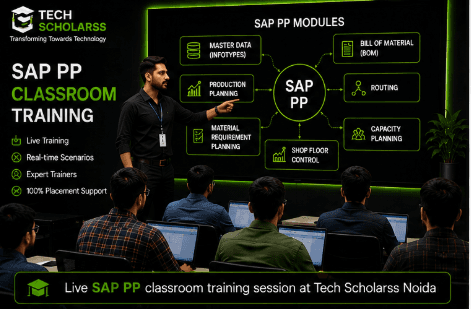
What Is SAP PP?
SAP PP (Production Planning) sits inside the SAP ERP suite and manages the entire manufacturing cycle — from demand planning through shop floor execution and period-end closing.
It covers both planning (what and when to produce) and execution (actual production orders and confirmations), making it a comprehensive manufacturing management system.
SAP PP Course Syllabus — 12 Modules
A complete, job-focused SAP PP syllabus is typically organized into the following 12 modules:
- •Module 1 – SAP Overview & ERP — ERP concepts, SAP navigation, organizational structure, S/4HANA basics
- •Module 2 – Master Data — Material Master, BOM creation, BOM types, data views
- •Module 3 – Work Centers & Routing — Work center configuration, capacity categories, routing creation
- •Module 4 – Demand Management — Planning strategies, requirement types, forecasting basics
- •Module 5 – Material Requirements Planning (MRP) — MRP configuration, lot sizing, planning runs
- •Module 6 – Production Orders — Order creation, availability checks, confirmations, settlement
- •Module 7 – Capacity Planning — Capacity evaluation, leveling, scheduling
- •Module 8 – Repetitive Manufacturing — REM profile setup, backflush confirmation
- •Module 9 – Goods Movement & MM Integration — Goods issue/receipt, component availability
- •Module 10 – Sales Order Driven Production — Make-to-order scenarios, variant configuration
- •Module 11 – Production Reporting & Period-End Closing — Settlement, variance analysis, COGI
- •Module 12 – Real Projects & Placement Prep — 7 live configuration projects, interviews
Master Data in SAP PP
Master data is the foundation of SAP PP — accurate master data determines whether MRP runs produce correct planned orders. Key objects include Material Master (defining product characteristics), Bills of Materials (multi-level product structures), and Routings (the steps and work centers needed to produce a product).
A well-designed master data setup is critical to successful SAP PP projects, which is why this module receives significant attention in the curriculum.
Demand Management
Demand management determines what needs to be produced. This includes sales forecasts, planned independent requirements, and consumption-based planning — all of which feed into the MRP run.
Production Orders
Production orders are the actual manufacturing directives — they specify what product, how much, and when it needs to be made. Students learn to create, release, confirm, and settle production orders, including handling of components, confirmations, and scrap.
Want the Full SAP PP Curriculum?
See the detailed module-wise curriculum and live project list on our main course page.
Explore SAP PP Course in Noida →Capacity Planning
Capacity planning ensures that planned production doesn't exceed available work center capacity. This module covers capacity evaluation, finite and infinite scheduling, and capacity leveling — techniques to resolve overloads.
Repetitive Manufacturing (REM)
REM is used for high-volume, steady-state production (like automotive assembly lines) where backflush-based confirmations replace individual component picks. Students learn REM profile setup and confirmation techniques.
SAP PP Module Integration
SAP PP doesn't exist in isolation — it integrates deeply with MM (materials), SD (sales), QM (quality), and FICO (finance). Understanding these touchpoints is critical to supporting real-world SAP environments.
Practical SAP PP Projects
7 real, resume-worthy configuration projects form the practical backbone of the curriculum — from simple plant setup through complex multi-plant scenarios and period-end closing.
SAP PP Course Duration
Covering all 12 modules properly with hands-on configuration and project work typically takes 5–6 months. Shorter crash courses compress or skip modules like capacity planning and REM, limiting job readiness.
Who Should Learn SAP PP?
This syllabus works well for B.Tech Mechanical/Production, MBA Operations, and BBA graduates. Working professionals from manufacturing, supply chain, and production planning backgrounds also fit well.
If you're from a non-manufacturing background, look for a course that covers manufacturing fundamentals early.
Frequently Asked Questions
What is included in the SAP PP syllabus?+
12 modules covering SAP basics, master data (Material, BOM, Routing), demand planning, MRP, production orders, capacity planning, REM, integration, and real projects.
How long does it take to complete the SAP PP syllabus?+
A complete program with hands-on practice typically takes 5–6 months.
Does the syllabus include Repetitive Manufacturing (REM)?+
Yes, Module 8 covers REM setup and backflush-based confirmation.
Is capacity planning and leveling covered?+
Yes, Module 7 covers finite/infinite scheduling, capacity evaluation, and leveling techniques.
Are real projects included in the syllabus?+
Yes, Module 12 includes 7 live configuration projects along with placement preparation.
Is this syllabus suitable for non-manufacturing graduates?+
Yes, as long as the course covers manufacturing fundamentals early.