What Is SAP PM?
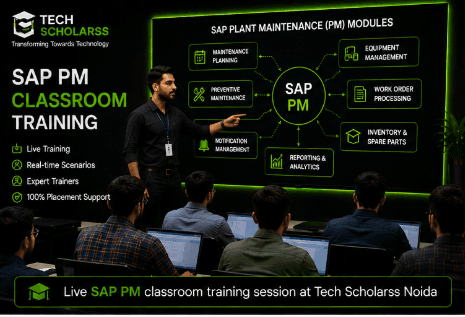
SAP PM stands for Plant Maintenance — the SAP module that manages an organization's equipment and assets, covering everything from equipment master data to breakdown repairs and scheduled preventive maintenance.
PM covers both technical data (functional locations, equipment master, bill of materials) and process execution (notifications, orders, maintenance plans, refurbishment), and integrates closely with Materials Management (MM), Production Planning (PP), and Finance & Controlling (FICO).
SAP PM Course Syllabus
A complete, job-focused SAP PM syllabus is typically organized into the following 12 modules:
- •Module 1 – Introduction to SAP & ERP: SAP overview, ERP concepts, organizational structure, S/4 HANA basics
- •Module 2 – PM Organizational Structure: Maintenance plant, planning plant, work centers, planner groups
- •Module 3 – Technical Objects: Functional locations, equipment master, BOM, serial numbers
- •Module 4 – Breakdown Maintenance: Notification types, malfunction reporting, order creation, damage codes
- •Module 5 – Preventive Maintenance: Maintenance strategies, maintenance plans, task lists, scheduling
- •Module 6 – Maintenance Order Processing: Order types, creation & release, resource planning, confirmation
- •Module 7 – Refurbishment Processing: Refurbishment order, material valuation, goods movement, settlement
- •Module 8 – Measuring Points & Counters: Measuring points, measurement documents, condition-based maintenance
- •Module 9 – Integration with MM & PP: Spare parts planning, purchase requisitions from orders, stock materials
- •Module 10 – Integration with FICO: Cost center assignment, settlement rules, order costing, budgeting
- •Module 11 – Maintenance Reporting & Fiori: Standard PM reports, Fiori apps, downtime analysis, KPI dashboards
- •Module 12 – Projects & Placement Preparation: 7 live configuration projects, resume and interview prep
This module structure mirrors the curriculum followed on the main course page. View curriculum →
Technical Objects in SAP PM
Technical objects are the foundation everything else in PM builds on. Functional locations describe where equipment sits within a plant structure, the equipment master describes the physical asset itself, and the bill of materials defines the spare parts and components tied to it. A good syllabus spends significant time here since incorrect technical-object data is the most common root cause of maintenance-processing errors in live systems.
Breakdown Maintenance
Breakdown maintenance covers unplanned equipment failures — a notification gets raised when something breaks, damage and cause codes are recorded, and a maintenance order is created to track the repair through to completion. This module covers the complete notification-to-order flow, along with common issues like incomplete damage-code recording, which are frequently tested in interviews since they reflect real day-to-day support work.
Preventive Maintenance
Preventive maintenance is about scheduling maintenance before something breaks — this module covers maintenance strategies, maintenance plans, task lists, and deadline monitoring. Understanding how strategies and task lists link together to generate maintenance orders automatically is a common scenario-based interview topic, since it reflects how most large plants actually reduce unplanned downtime.
Want the Full SAP PM Curriculum?
See the detailed module-wise curriculum, live project list, and batch timings on our main course page.
Explore SAP PM Course in Noida →Refurbishment & Measuring Points
Refurbishment processing handles repairable spare parts — instead of scrapping a damaged component, it gets refurbished and put back into usable stock, with proper valuation and settlement along the way. Measuring points and counters, on the other hand, support condition-based maintenance, where maintenance is triggered by actual usage or wear readings rather than a fixed calendar. Together, these two topics separate a strong candidate from someone who only knows basic breakdown and preventive maintenance.
SAP PM Integration with Other Modules
PM rarely works in isolation — understanding how it connects to other modules is often what separates a strong candidate from an average one.
- •PM + MM: Spare parts planning, purchase requisitions triggered from maintenance orders, stock and non-stock materials
- •PM + PP: Coordinating maintenance windows with production schedules to minimize downtime impact
- •PM + FICO: Cost center assignment, settlement rules, and maintenance budgeting
Practical SAP PM Projects
Modules alone don't prepare you for interviews — real configuration projects do. A good SAP PM program includes hands-on project work such as setting up a maintenance plant structure from scratch, building a full equipment hierarchy with functional locations, configuring a complete breakdown-maintenance flow, and building a preventive maintenance plan with scheduling.
The most valuable projects are the ones that combine preventive maintenance with cost settlement and reporting, since that's where most real-world implementation work — and most interview questions — actually happen.
SAP PM Course Duration
Covering all 12 modules properly, along with hands-on configuration practice and project work, typically takes 5–6 months when taught progressively. Shorter crash courses exist but usually compress or skip the refurbishment and measuring-points modules, which limits how job-ready you are at the end.
Who Should Learn SAP PM?
This syllabus works well for B.Tech Mechanical/Electrical graduates and Diploma Engineers, since the module structure closely follows maintenance concepts they've already studied. BSc and Industrial Engineering graduates and working professionals moving from maintenance or reliability roles also fit well into this curriculum.
If you're from a non-technical background, look for a course that spends time on core maintenance fundamentals in Module 3 before moving deeper into SAP-specific configuration.
SAP PM Career Opportunities
This syllabus maps directly to roles such as SAP PM Consultant, SAP Functional Consultant, SAP Support Consultant, and SAP Implementation Consultant. Demand for these roles comes largely from IT consulting firms and SAP implementation partners running maintenance and asset-management rollout projects for manufacturing, power, and industrial clients.
See the full career breakdown here: View curriculum →
How to Choose an SAP PM Course
When comparing syllabuses across institutes, it's worth checking a few things directly:
- •Does the syllabus include refurbishment and measuring points in depth?
- •Is integration with MM/PP/FICO covered, or only theory?
- •How many real configuration projects are included in Module 12?
- •Is training delivered on S/4HANA / Fiori EAM apps, or only the older ECC-style screens?
- •Are trainers implementation-qualified, not just SAP-technical trainers?
Frequently Asked Questions
What is included in the SAP PM syllabus?+
The syllabus covers 12 modules — SAP & ERP basics, PM organizational structure, technical objects, breakdown and preventive maintenance, order processing, refurbishment, measuring points, integration with MM/PP/FICO, reporting, and a final projects module.
How long does it take to complete the SAP PM syllabus?+
A complete, progressively taught program covering all 12 modules with hands-on practice typically takes 5–6 months.
Does the syllabus include refurbishment processing?+
Yes, Module 7 covers refurbishment orders, material valuation, goods movement, and settlement in detail.
Are measuring points and condition-based maintenance covered?+
Yes, Module 8 covers measuring points, counters, measurement documents, and condition-based maintenance.
Are real projects included in the syllabus?+
Yes, Module 12 includes 7 live configuration projects along with resume and interview preparation.
Is this syllabus suitable for non-technical graduates?+
Yes, as long as the course covers core maintenance fundamentals early on before moving into SAP-specific configuration.
Where can I check the SAP PM course fees?+
See the detailed SAP PM course fees guide for what's typically included in the fee across different program types.