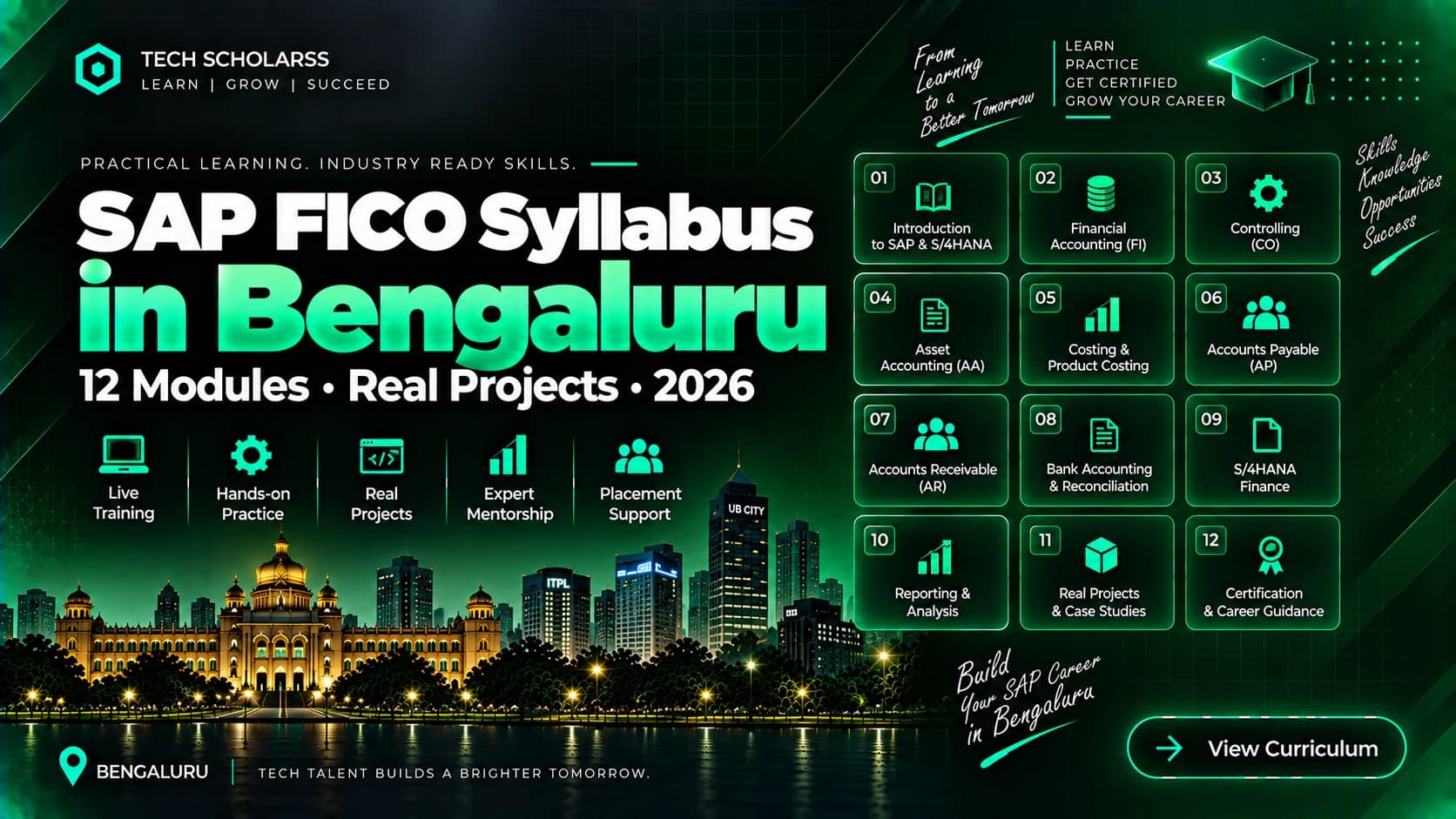
What SAP FICO Actually Is
SAP FICO is shorthand for two connected SAP modules — Financial Accounting (FI) and Controlling (CO) — used to run financial reporting, cost tracking, and internal management analysis inside an organization.
FI itself branches into General Ledger, Accounts Payable, Accounts Receivable, Asset Accounting, and Bank Accounting. CO deals with internal cost visibility — cost centers, profit centers, internal orders, and the reporting built on top of them.
For Bengaluru learners, understanding the underlying finance logic matters just as much as memorizing where each setting lives inside SAP — arguably more, since interviewers usually probe the 'why' more than the 'where'.
The Complete SAP FICO Syllabus
A syllabus worth its salt should build progressively — SAP basics first, then FI, then CO, then tax handling, integration, closing procedures, and finally real project work and interview prep.
Here's how Tech Scholarss structures the 12 modules for Bengaluru learners:
- •Module 1 – Introduction to SAP & ERP: what ERP is, SAP overview and navigation, organizational structure, S/4HANA basics with Bengaluru IT services & GCC examples
- •Module 2 – Enterprise Structure for Bengaluru Multi-Entity & GCC Setups: Company & Company Code for multi-entity IT services firms, Business Area for Bengaluru product & GCC organizations, Controlling Area for shared service centers, Fiscal Year Variant (India + global delivery), Posting Period Variant for GCC closing calendars, Document Types for IT services & consulting scenarios
- •Module 3 – General Ledger Accounting for Bengaluru IT Services & GCCs: Chart of Accounts (India + global for GCC reporting), GL master data for multi-entity Bengaluru firms, posting & clearing in IT services scenarios, parked entries in GCC workflows, foreign currency valuation for global delivery centers
- •Module 4 – Accounts Payable for Bengaluru Enterprises: vendor master data (domestic + import for IT services), invoice processing with 3-way match in GCC shared services, payment terms for Bengaluru vendor ecosystem, automatic payment program for multi-entity firms, vendor reconciliation in product & consulting setups
- •Module 5 – Accounts Receivable for IT Services & Product Companies: customer master data (B2B services + SaaS), invoicing for IT services & product subscriptions, dunning configuration for GCC & product clients, incoming payments in multi-currency setups, credit management for Bengaluru enterprise clients
- •Module 6 – Asset Accounting for Corporate & IT Assets: asset classes (corporate + IT assets for Bengaluru firms), depreciation areas (Companies Act + Income Tax), acquisition & capitalization in IT services, retirement & transfer in GCC setups, depreciation run for Bengaluru enterprise closings
- •Module 7 – Bank Accounting & Treasury (Bengaluru Banking Ecosystem): house banks for Bengaluru multi-bank operations, bank reconciliation (manual + auto) in GCC workflows, Electronic Bank Statement (EBS) for IT services, check management for product & consulting firms, cash journal for Bengaluru shared service centers
- •Module 8 – Controlling: Cost Element & Cost Center for Bengaluru GCCs: cost elements (primary + secondary) in GCC setups, cost centers & groups for IT services & product firms, activity types in Bengaluru shared service centers, statistical key figures for GCC cost allocation, cost center reporting for Bengaluru enterprise finance
- •Module 9 – Controlling: Profit Center & Internal Orders for Bengaluru Enterprises: profit center structure for Bengaluru product & GCC firms, profit center assignment in multi-entity IT services, internal orders for Bengaluru project & client tracking, assessment & distribution in shared service centers, profitability analysis for Bengaluru enterprise reporting
- •Module 10 – Taxation & GST for Multi-State Operations (Karnataka Focus): tax procedure configuration for Karnataka entities, GST setup (CGST, SGST, IGST) for Bengaluru multi-state firms, input & output tax in IT services & product scenarios, withholding tax (TDS) for Bengaluru enterprises, GSTR reporting for GCC & shared service centers
- •Module 11 – FI Integration with MM & SD (Bengaluru IT Services P2P & O2C): FI-MM integration (procure-to-pay) in Bengaluru IT services, FI-SD integration (order-to-cash) in product & GCC setups, automatic account determination for multi-entity firms, GR/IR clearing in Bengaluru shared service workflows, end-to-end business flow for Bengaluru enterprise clients
- •Module 12 – S/4HANA Finance & Career Prep (Bengaluru IT & GCC Hiring): Universal Journal for Bengaluru enterprise reporting, Fiori for finance in GCC & product company setups, real-time reporting for Bengaluru finance teams, 7 live configuration projects (Bengaluru scenarios), Bengaluru-style resume & mock interviews for IT & GCC roles
The full topic-wise curriculum is available on the main SAP FICO Course in Bengaluru page. View curriculum →
Hands-on SAP FICO Projects
Reading about a configuration step and actually setting it up inside SAP are two very different experiences — practical project work is what closes that gap and makes the finance logic stick.
Projects also matter a lot at interview time, when you'll often be asked to walk through how you'd configure an entire process from scratch.
- •Multi-Entity Company Code Setup for Bengaluru IT Services (Whitefield & Electronic City firms)
- •GST Configuration for Karnataka Multi-State Operations (CGST, SGST, IGST)
- •Vendor Master & Automatic Payment Program for Bengaluru GCC Setup (ORR & Whitefield corridors)
- •Asset Accounting for Bengaluru IT & Product Companies (Electronic City & ITPL)
- •Profit Center & Internal Order Setup for Bengaluru Enterprises (consulting & product subsidiaries)
- •Cost Center Planning for Bengaluru GCCs & Shared Services (Whitefield & ORR)
- •Month-End & Year-End Closing Simulation (Bengaluru GCC Client Style)
- •Bank Accounting with Electronic Bank Statement (EBS) for Bengaluru Banks
- •Chart of Accounts Setup (India + Global) for Multi-Entity Firms
- •General Ledger Configuration with Parallel Ledgers
- •FI-MM Integration Exercise (Procure-to-Pay) in Bengaluru IT Services
- •FI-SD Integration Exercise (Order-to-Cash) in Product & GCC Setups
- •Full End-to-End SAP FICO Configuration Project
Online vs Classroom SAP FICO Training in Bengaluru
Both online and offline batches can be run live — the real difference is in the day-to-day experience. Offline means committing to travel on a fixed schedule; live online lets you join from wherever's convenient across Bengaluru.
A well-run online program keeps everything you'd get in a classroom — real teaching, real interaction — while cutting out the commute. You still get to ask questions, share your screen, work remotely on the SAP system, and attend from a location that fits your day.
The format itself matters less than whether the program is genuinely instructor-led, gives you real SAP access, includes projects, and backs it up with individual support and career prep.
| Factor | Live Online | Classroom |
|---|---|---|
| Travel | None needed | Regular commute required across Bengaluru |
| Teaching Style | Live, instructor-led | Live, in-person |
| SAP Practice | Remote GUI / S/4HANA access | Depends on the institute's lab |
| Scheduling Flexibility | Easier to fit around work/college | Fixed classroom hours |
| Individual Attention | 1-to-1 mentoring can be added on | Depends heavily on the trainer |
1-to-1 Mentoring Alongside the SAP FICO Syllabus
A batch curriculum, by design, moves at a pace that suits the average learner — which means some people fall behind on specific topics while others end up bored waiting for the class to catch up.
Individual mentoring fixes that gap. Tech Scholarss runs 1-to-1 mentor sessions alongside the regular live classes, so Bengaluru learners get personal direction on top of the structured curriculum, not instead of it.
This tends to help most for people who are completely new to SAP, switching careers into it, or need extra support pulling a project together for interviews.
- •Doubt clearing, one-on-one
- •A learning plan built around your pace
- •Configuration guidance when you're stuck
- •Help with assignments
- •Direction on project work
- •A revision schedule that actually fits
- •Resume review tailored for SAP roles
- •Technical interview rehearsal
- •HR round preparation
Want the Complete SAP FICO Curriculum?
See the full 12-module syllabus, project list, live SAP practice details, batch timings, and 1-to-1 mentor support for Bengaluru learners.
Explore SAP FICO Course in Bengaluru →How Long the SAP FICO Course Runs for Bengaluru Learners
Trying to cram FI, CO, tax handling, integration, projects, and interview prep into a couple of weeks usually means one piece gets shortchanged — and it's often the hands-on practice that suffers first.
Tech Scholarss spreads the 12 modules across a 5–6 month roadmap instead, giving each stage enough breathing room.
| Timeframe | Focus Area | What You Should Be Able to Do |
|---|---|---|
| Month 1–2 | SAP Fundamentals + Core FI | Handle GL, AP, and AR processes confidently |
| Month 3 | Asset & Bank Accounting | Manage asset lifecycle and bank-related setups |
| Month 4 | Controlling | Work with cost centers, profit centers, internal orders |
| Month 5 | GST & Integration | Configure tax logic for multi-state operations and MM/SD linkages |
| Month 6 | Projects & Career Prep | Complete real projects, sharpen resume and interview answers |
Who Should Actually Take This Course
SAP FICO fits well for anyone drawn to finance, accounting, ERP systems, or functional consulting work. A finance background makes early modules easier, though it's not a strict requirement.
That includes B.Com, M.Com, MBA Finance, and BBA graduates, working accountants, Tally users, CA/CMA candidates, working professionals in Bengaluru looking for a change, and complete freshers.
Skills You'll Actually Build
A syllabus is only worth something if it translates into skills you can talk about confidently in a job setting, not just definitions memorized for an exam.
By the time you're through the modules and project work, you should be comfortable with:
- •FI and CO business logic
- •General Ledger configuration with parallel ledgers
- •Accounts Payable and Accounts Receivable workflows
- •Asset Accounting for corporate + IT assets
- •Bank Accounting with Electronic Bank Statement
- •Cost Center Accounting
- •Profit Center Accounting
- •Internal Orders for project tracking
- •GST configuration for multi-state operations
- •FI-MM integration (procure-to-pay)
- •FI-SD integration (order-to-cash)
- •Month-end and year-end closing
- •Practical exposure to S/4HANA and Universal Journal
- •Handling scenario-based interview questions
Where the SAP FICO Syllabus Can Take You
Depending on your background and how strong your project work is, this syllabus can lead to a range of roles across support, consulting, and finance-analysis functions.
Common titles include SAP FICO Consultant, SAP Support Consultant, SAP Implementation Consultant, SAP Functional Consultant, and SAP Finance Analyst.
Learning via live online sessions from Bengaluru also means you're not restricted to local opportunities — SAP roles are scattered across the country, with many offering remote or hybrid setups.
How to Judge a Course by Its Syllabus
The syllabus should be one of your first checks — a long topic list means little if the course can't actually give you hands-on access to practice any of it.
- •Confirm all 12 modules are actually taught, not skimmed over
- •Check whether sessions are truly live or mostly recorded
- •Verify you'll get real SAP GUI / S/4HANA access
- •Ask how many genuine configuration projects are included
- •Check that FI-MM and FI-SD integration are actually covered
- •Confirm GST and multi-state taxation is part of the syllabus
- •Ask how quickly doubts get resolved
- •Confirm 1-to-1 mentoring is actually offered
- •Check what resume and interview support looks like
- •Understand exactly what 'career guidance' includes
Frequently Asked Questions
QHow many modules make up the SAP FICO syllabus for Bengaluru learners?+
Tech Scholarss structures the course into 12 progressive modules covering SAP fundamentals, FI, CO, taxation, integration, closing, real projects, and career prep.
QIs GST for multi-state operations part of the syllabus?+
Yes — it's covered under taxation, including tax procedures, GST setup (CGST, SGST, IGST), input/output tax, withholding tax, and GSTR reporting.
QDoes the course cover FI-MM and FI-SD integration?+
Yes, that's Module 11 — covering integration between Finance and both Materials Management and Sales & Distribution, with end-to-end business flow exercises.
QWill I actually work on real projects, or is it mostly lecture-based?+
There's real practical configuration work involved, covering company codes, GST setup, vendor accounting, asset accounting, Controlling, integration, and closing activities.
QCan I take this course online from Bengaluru?+
Yes — it's delivered entirely through live, instructor-led online sessions with real SAP system practice.
QIs 1-to-1 mentoring actually included for Bengaluru learners?+
Yes — alongside the group classes, you get dedicated mentor support for doubts, projects, revision, resume work, and interview prep.
QIs online training genuinely as good as classroom training?+
It can be, and often more convenient, since it removes daily travel across Bengaluru while keeping live interaction with the trainer intact. What actually matters is teaching quality, SAP access, and support — not the format itself.
QHow long does the whole syllabus take to complete?+
The Tech Scholarss roadmap runs 5–6 months across the 12 modules, including practice, project work, and career prep.
QHow does the Bengaluru syllabus differ from other cities?+
The Bengaluru syllabus is tailored for the city's IT services, GCC, and product company ecosystem — with modules covering multi-entity setups, GCC shared service workflows, Karnataka GST scenarios, and S/4HANA Finance projects modeled on Whitefield, Electronic City, and ORR enterprise environments.
QDoes the syllabus cover Karnataka-specific GST compliance?+
Yes — Module 10 covers GST for multi-state operations with Karnataka focus, including CGST, SGST, IGST, place-of-supply logic for inter-state transactions, and GSTR reporting for Bengaluru-based entities.
Written by Tech Scholarss Team
SAP FICO training specialists with 8+ years of experience in enterprise ERP training. We help learners across India — including Bengaluru and Karnataka — build practical SAP skills with live S/4HANA training, real projects, and 1-to-1 mentor support.