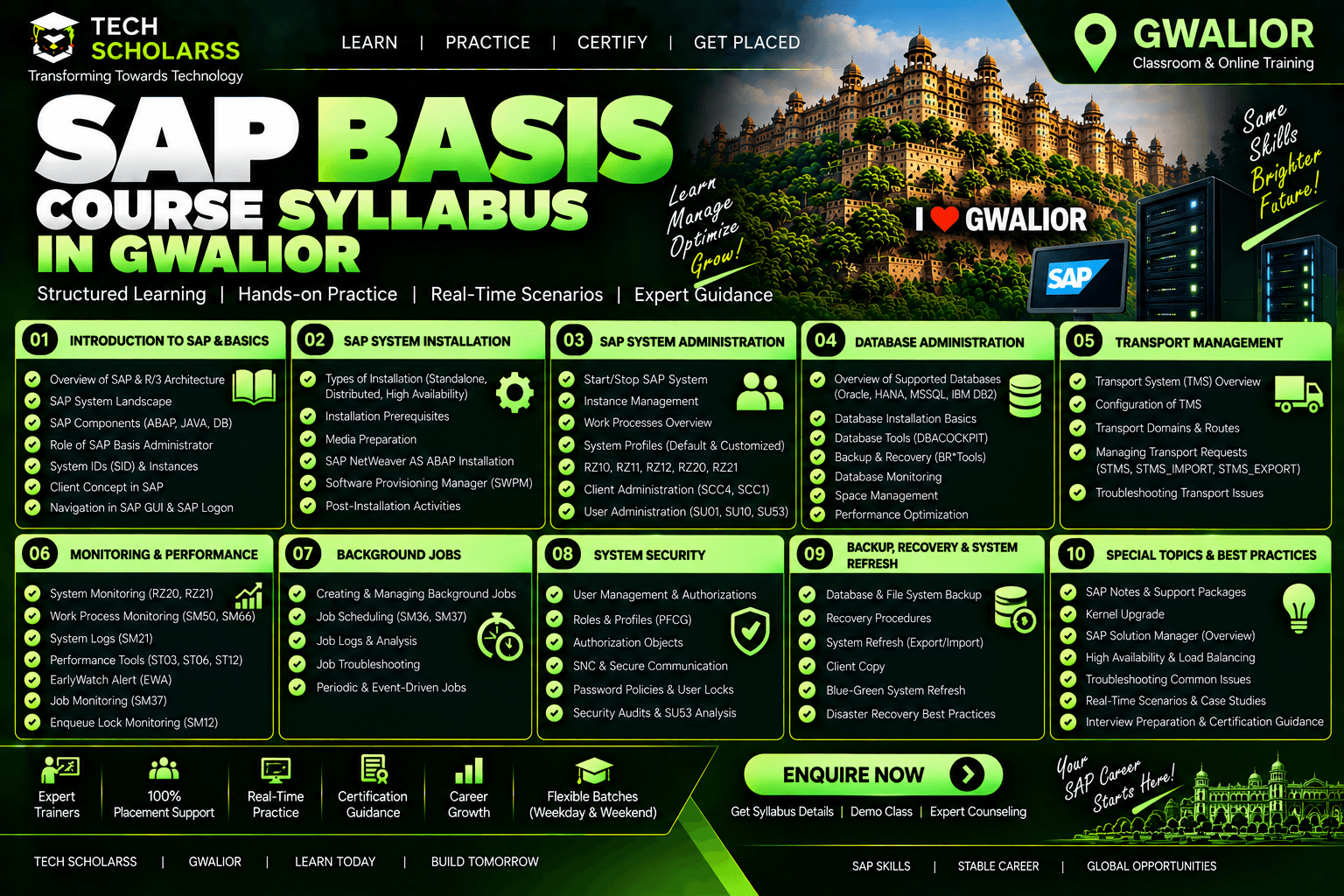
What Is SAP BASIS?
SAP BASIS refers to the technical administration layer that keeps an SAP system running — covering installation, client and user management, transport control, monitoring, database basics, and security.
SAP BASIS work includes setting up application servers, managing clients, controlling how changes move between systems, scheduling background jobs, monitoring performance, and maintaining backup and recovery plans.
For learners in Gwalior, understanding the landscape concept behind each administration activity is just as important as learning the transaction or configuration steps themselves.
Complete SAP BASIS Course Syllabus in Gwalior
A complete job-focused syllabus should move progressively from SAP landscape fundamentals to installation, client administration, transports, monitoring, database basics, security, and practical tasks.
The Tech Scholarss SAP BASIS course is structured around the following 12 modules:
- •Module 1 – Introduction to SAP & ERP Landscapes: ERP concepts, landscape overview, SAP navigation, client and instance concepts, and S/4HANA basics
- •Module 2 – SAP System Installation & Architecture: application server architecture, installation prerequisites, instance types, kernel and work processes, and startup/shutdown procedures
- •Module 3 – Client Administration: client creation, client copy, client export/import, client settings, and client deletion
- •Module 4 – User & Authorization Management: user master records, roles and profiles, authorization objects, SU01/PFCG concepts, and password and security policies
- •Module 5 – Transport Management System: TMS configuration, transport routes, transport requests, import queues, and transport troubleshooting
- •Module 6 – Background Job & Print Administration: job scheduling, job monitoring, spool administration, output devices, and job troubleshooting
- •Module 7 – System Monitoring & Performance: work process monitoring, system logs, performance analysis, memory management, and alert monitoring
- •Module 8 – Database Administration Basics: HANA database overview, DBACockpit basics, backup strategies, database monitoring, and space management
- •Module 9 – SAP Security Fundamentals: security architecture, segregation of duties basics, audit and logging, secure network communication basics, and patch/note management
- •Module 10 – System Refresh & Upgrade Concepts: system refresh overview, support package stacks, upgrade planning basics, downtime management, and post-upgrade checks
- •Module 11 – High Availability & Backup Strategy: high availability concepts, backup and recovery planning, disaster recovery basics, system copy concepts, and landscape documentation
- •Module 12 – Real Projects & Placement Preparation: end-to-end administration tasks, portfolio setup, resume preparation, mock interviews, and HR preparation
For the full visual curriculum and topic-wise breakdown, visit the main SAP BASIS Course in Gwalior page. View curriculum →
Practical SAP BASIS Admin Tasks
Knowing the theory is only one part of SAP BASIS training. Practical administration helps learners understand how a landscape actually behaves under real conditions.
Task-based work should connect individual modules with realistic support and implementation scenarios. This is especially useful during interviews where candidates may be asked to explain how they would troubleshoot a specific system issue.
- •Client Build and Configuration
- •Client Copy and Client Export/Import
- •Role and Authorization Setup
- •Transport Route Design
- •Transport Request Troubleshooting
- •Background Job Scheduling and Monitoring
- •Spool and Print Administration
- •Performance Monitoring Setup
- •Database Backup and Recovery Simulation
- •System Refresh Checklist Walkthrough
- •Security and Audit Log Review
- •End-to-End Landscape Administration Task
Online vs Offline SAP BASIS Training in Gwalior
For Gwalior learners, online and offline training can both be live, but the overall learning experience can be different. Offline classes require regular travel to a fixed location, while live online classes allow students to participate from their own location.
A strong live online SAP BASIS program keeps the benefits of live teaching while reducing the time spent commuting. Students can interact with the trainer, ask questions, share screens, work on SAP remotely, and attend from a location that fits their routine.
The real issue is not online versus offline by itself. The important question is whether the online program is genuinely instructor-led and whether it provides SAP system access, practical administration tasks, individual support, and career preparation.
| Factor | Live Online | Offline Classroom |
|---|---|---|
| Travel | No daily commute | Regular travel required |
| Teaching | Live instructor-led | Live classroom teaching |
| SAP Practice | Remote SAP system access | Depends on lab and institute setup |
| Flexibility | Easier around college/work | Fixed location and schedule |
| Individual Support | 1-to-1 mentor support can be added | Depends on trainer/institute |
1-to-1 Mentor Support During SAP BASIS Training
A fixed classroom curriculum is designed for the whole batch, but each learner has different strengths and weaknesses. Individual mentoring creates an additional layer of support for topics that require more attention.
Tech Scholarss provides dedicated 1-to-1 mentor guidance alongside live SAP BASIS classes. The purpose is to help learners receive personalized direction instead of relying only on group sessions.
Mentor guidance can be particularly useful for learners who are new to SAP, are transitioning from general IT roles, or need additional support with administration tasks and interviews.
- •Individual doubt resolution
- •Personal learning plan
- •Administration-task guidance
- •Assignment support
- •Task-explanation practice
- •Revision planning
- •Resume review
- •Technical interview practice
- •HR interview preparation
Want the Full SAP BASIS Curriculum?
See the complete 12-module syllabus, practical admin-task list, SAP system practice, batch timings, and 1-to-1 mentor support.
Explore SAP BASIS Course in Gwalior →SAP BASIS Course Duration in Gwalior
A complete SAP BASIS course should provide enough time for learning, practice, revision, and administration tasks. Trying to compress installation concepts, client administration, transports, monitoring, database basics, security, and interview preparation into a few weeks can reduce the amount of practical exposure a learner receives.
The Tech Scholarss roadmap follows a progressive 5–6 month structure covering all 12 modules.
| Period | Focus | Learning Outcome |
|---|---|---|
| Month 1–2 | Landscape Foundations | Architecture, installation concepts, and client administration |
| Month 3 | Users, Roles & Transports | Authorization management and transport route configuration |
| Month 4 | Monitoring & Background Jobs | Job scheduling, spool administration, and performance monitoring |
| Month 5 | Database & Security | HANA administration basics and SAP security fundamentals |
| Month 6 | Projects & Placement | Administration tasks, resume, and interview preparation |
Who Should Learn SAP BASIS?
SAP BASIS is a strong fit for learners interested in system administration, infrastructure, databases, and enterprise IT operations. A technical or IT background can make the subject easier, but prior SAP experience is not mandatory.
BCA, B.Tech, MCA graduates, system administrators, network engineers, database professionals, IT support staff, working professionals, and freshers can explore the course depending on their goals.
Skills You Can Build From the SAP BASIS Syllabus
A complete SAP BASIS syllabus should result in practical knowledge rather than only theoretical familiarity.
By progressing through the modules and practical work, learners can build familiarity with:
- •SAP landscape architecture
- •Client administration
- •User and authorization management
- •Transport management system configuration
- •Background job scheduling and monitoring
- •System performance monitoring
- •HANA database administration basics
- •SAP security fundamentals
- •System refresh and upgrade concepts
- •Backup and recovery planning
- •S/4HANA practical exposure
- •Scenario-based interview preparation
SAP BASIS Career Opportunities
The SAP BASIS syllabus prepares learners for different roles depending on their background, experience, practical skill, and interview performance.
Common career paths include SAP BASIS Consultant, SAP BASIS Support Consultant, SAP Implementation Consultant (BASIS), SAP Security & Authorization Analyst, and SAP Transport Administrator.
Learners from Gwalior can also apply beyond the local city because SAP opportunities can be distributed across multiple locations and may include remote or hybrid roles.
How to Choose an SAP BASIS Course
The syllabus should be one of the first things you compare when selecting a training provider. A long list of topics is less useful if the course does not provide practical SAP access or guidance.
- •Check whether all 12 modules are covered properly
- •Ask whether classes are live or mostly recorded
- •Verify SAP system access for administration practice
- •Ask how many real administration tasks are included
- •Check transport management and monitoring coverage
- •Ask about database and security fundamentals
- •Check how doubts are resolved
- •Ask whether 1-to-1 mentor support is included
- •Check resume and interview preparation
- •Understand the actual placement support offered
Frequently Asked Questions
How many modules are there in the SAP BASIS syllabus?+
The Tech Scholarss SAP BASIS curriculum is structured into 12 progressive modules covering landscape fundamentals, installation, client and user administration, transports, monitoring, database basics, security, and placement preparation.
Does the SAP BASIS syllabus include HANA database administration?+
Yes. Module 8 covers HANA database administration basics, including DBACockpit navigation, backup strategies, and database monitoring.
Does the syllabus include transport management?+
Yes. Module 5 covers TMS configuration, transport routes, transport requests, and transport troubleshooting in detail.
Are practical administration tasks included?+
Yes. The program includes practical scenarios covering client setup, role design, transport routes, background jobs, monitoring, and backup planning.
Is SAP BASIS training online in Gwalior?+
Yes. The program is delivered through 100% live online instructor-led classes with practical SAP system exposure.
Does Tech Scholarss provide 1-to-1 mentor support?+
Yes. Dedicated 1-to-1 mentor guidance is provided alongside group training for individual doubts, tasks, revision, resume, and interview preparation.
Is online training better than offline training?+
Live online training can offer greater flexibility and removes daily travel. The actual value depends on the quality of live teaching, SAP system access, tasks, and support.
How long does the complete SAP BASIS syllabus take?+
The Tech Scholarss curriculum follows a structured 5–6 month learning roadmap for the 12 modules, practical work, admin tasks, and placement preparation.