What Is SAP BASIS?
SAP BASIS is the technical foundation and administration layer of the SAP ERP suite, covering system installation, client administration, user access, transports, monitoring, and database management.
BASIS covers classic system administration (installation, client management, authorization, transports, monitoring) as well as modern S/4 HANA administration (HANA database management, cloud-landscape concepts). Together, these form the technical backbone that keeps every SAP implementation running.
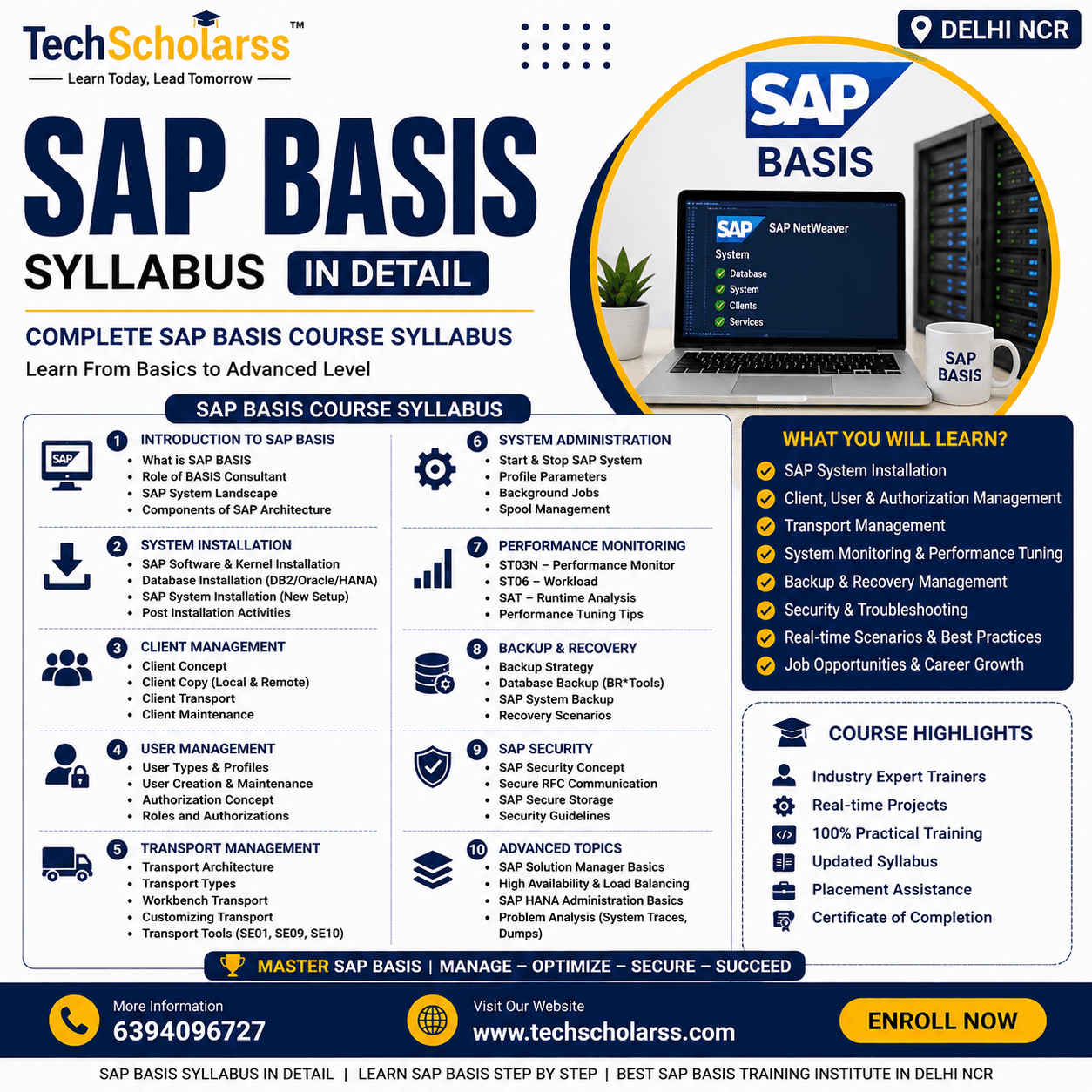
SAP BASIS Course Syllabus
A complete, job-focused SAP BASIS syllabus is typically organized into the following 12 modules:
- •Module 1 – Introduction to SAP & ERP: SAP overview, ERP concepts, architecture, SAP S/4 HANA basics
- •Module 2 – SAP Installation & Landscape: Installation prerequisites, instance setup, SAP kernel, OS/database overview
- •Module 3 – Client Administration: Client creation, copy, export/import, settings, deletion
- •Module 4 – User & Authorization Management: User master records, roles/profiles (PFCG), authorization objects
- •Module 5 – Transport Management System (TMS): Transport domain, routes, CTS, transport requests
- •Module 6 – System Monitoring & Performance: Work process monitoring, system log, ST22 dump analysis, background jobs
- •Module 7 – Database Administration Basics: Backup/restore, database monitoring, HANA database administration
- •Module 8 – Patch Management & Upgrades: Support packages, kernel upgrades, system refresh, SPAM/SAINT
- •Module 9 – Printing & Spool Administration: Spool administration, output devices, print requests
- •Module 10 – SAP Security & System Hardening: Security audit log, password policies, SNC, GRC overview
- •Module 11 – S/4 HANA Administration: HANA landscape, system replication, cloud concepts, Fiori launchpad
- •Module 12 – Projects & Placement Preparation: 7 live administration projects, resume and interview prep
This module structure mirrors the curriculum followed on the main course page. View curriculum →
Client Administration
Client administration is one of the most fundamental BASIS activities — creating clients, copying them between systems, exporting and importing client data, and managing client-specific settings. A good syllabus spends significant time here since client administration is where most new BASIS administrators get their first real hands-on exposure in a live environment.
Transport Management System
TMS governs how changes move safely from development to production — configuring the transport domain, setting up transport routes, and managing the Change & Transport System (CTS). This is tested frequently in interviews since it requires understanding both the technical configuration and the change-management process that surrounds it.
System Monitoring & Performance
Monitoring covers watching work processes, analyzing system logs (SM21), reviewing dumps (ST22), and managing background jobs (SM36/SM37). This module also covers basic performance tuning, which is a common scenario-based interview topic since real production issues often require diagnosing exactly where a bottleneck is coming from.
Want the Full SAP BASIS Curriculum?
See the detailed module-wise curriculum, live project list, and batch timings on our main course page.
Explore SAP BASIS Course in Delhi →SAP BASIS & S/4 HANA Integration
Modern BASIS administration is increasingly built around HANA-specific and cloud-landscape concepts rather than classic ECC-style administration alone — understanding how they connect is often what separates a strong candidate from an average one.
- •BASIS + HANA Database Administration: Manage the in-memory HANA database layer instead of a traditional disk-based database
- •BASIS + System Replication: Configure HANA system replication for high availability and disaster recovery
- •BASIS + Cloud Landscape: Administer SAP landscapes running on AWS or Azure infrastructure
Practical SAP BASIS Projects
Modules alone don't prepare you for interviews — real administration projects do. A good SAP BASIS program includes hands-on project work such as building and copying a client from scratch, designing roles and authorization profiles, configuring a full transport landscape, and setting up a system monitoring dashboard.
The most valuable projects are the ones that combine database backup strategy with a simulated S/4 HANA landscape, since that's where most real-world implementation work — and most interview questions — actually happen.
SAP BASIS Course Duration
Covering all 12 modules properly, along with hands-on administration practice and project work, typically takes 5–6 months when taught progressively. Shorter crash courses exist but usually compress or skip the security hardening and S/4HANA administration modules, which limits how job-ready you are at the end.
Who Should Learn SAP BASIS?
This syllabus works well for B.Tech, BCA, MCA graduates, and system-administration professionals, since the module structure closely follows infrastructure concepts they've already studied. Working professionals moving from general sysadmin or database administration roles, and support engineers looking to move into SAP consulting, also fit well into this curriculum.
If you're from a non-technical background, look for a course that spends time on core OS, database, and networking fundamentals in Module 2 before moving deeper into SAP-specific administration.
SAP BASIS Career Opportunities
This syllabus maps directly to roles such as SAP BASIS Administrator, SAP Support Consultant, SAP Migration Consultant, and SAP Cloud/HANA Administrator. Demand for these roles comes largely from IT consulting firms and SAP implementation partners running system administration projects.
See the full career breakdown here: View curriculum →
How to Choose an SAP BASIS Course
When comparing syllabuses across institutes, it's worth checking a few things directly:
- •Does the syllabus include HANA database administration in depth?
- •Is cloud-landscape administration covered, or only theory?
- •How many real administration projects are included in Module 12?
- •Is training delivered on S/4HANA, or only the older ECC-style environment?
- •Are trainers implementation-qualified, not just SAP-technical trainers?
Frequently Asked Questions
What is included in the SAP BASIS syllabus?+
The syllabus covers 12 modules — SAP & ERP basics, installation, client administration, user & authorization management, TMS, monitoring, database administration, patching, security, S/4HANA administration, and a final projects module.
How long does it take to complete the SAP BASIS syllabus?+
A complete, progressively taught program covering all 12 modules with hands-on practice typically takes 5–6 months.
Does the syllabus include database administration?+
Yes, Module 7 covers database backup and restore, monitoring, and HANA database administration basics.
Is S/4 HANA administration covered in the syllabus?+
Yes, Module 11 covers HANA landscape overview, system replication basics, cloud landscape concepts, and Fiori launchpad administration.
Are real projects included in the syllabus?+
Yes, Module 12 includes 7 live administration projects along with resume and interview preparation.
Is this syllabus suitable for non-technical graduates?+
Yes, as long as the course covers core OS, database, and networking fundamentals early on before moving into SAP-specific administration.
Where can I check the SAP BASIS course fees?+
See the detailed SAP BASIS course fees guide for what's typically included in the fee across different program types.