Introduction
SAP ABAP is a technical development path that combines programming with SAP application knowledge. A complete curriculum should move from programming fundamentals to database development, reports, debugging, object-oriented programming, enhancements, interfaces and modern S/4HANA development concepts. This Gwalior-focused guide explains the syllabus module by module.
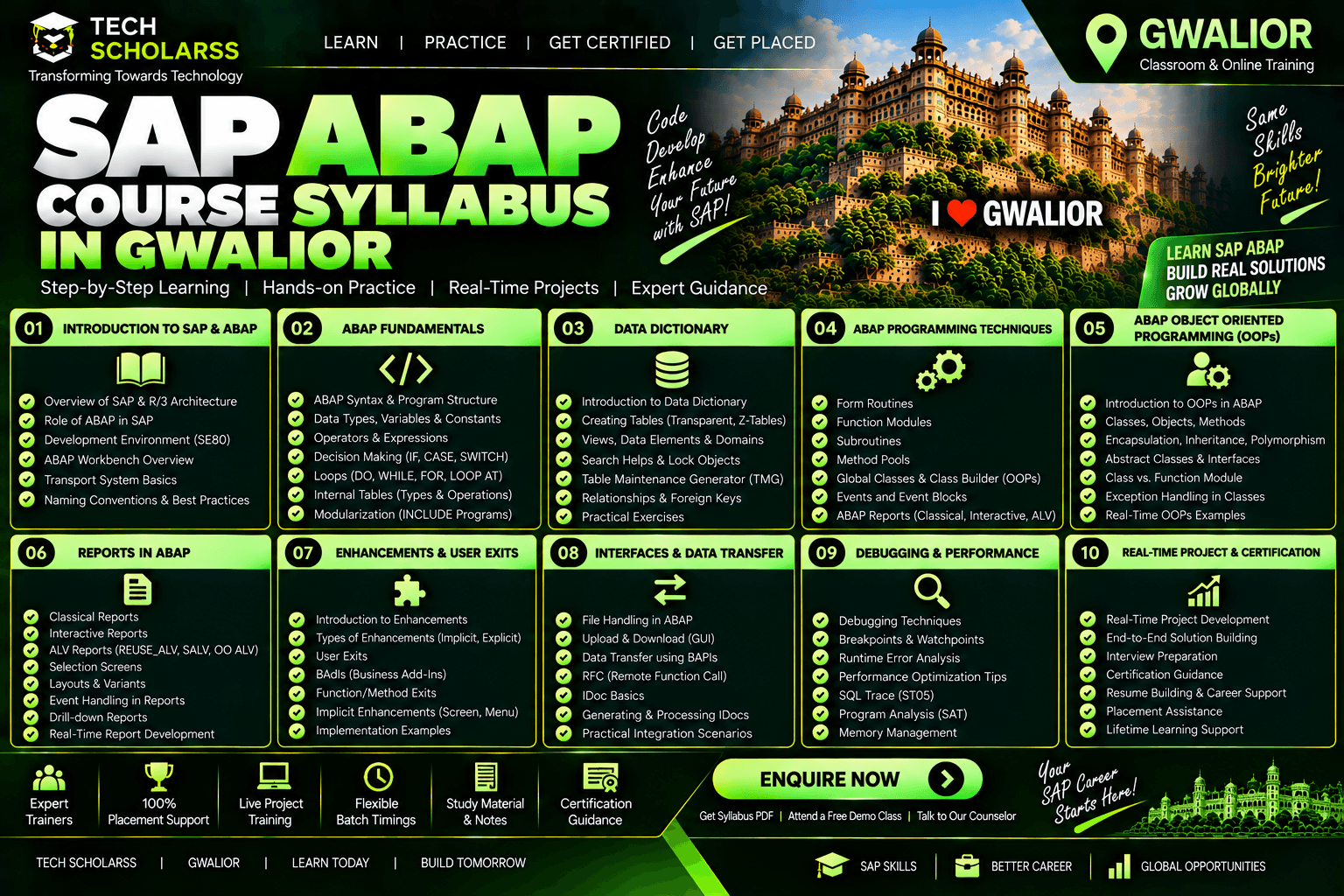
Complete SAP ABAP Syllabus in Gwalior
The SAP ABAP curriculum should move progressively from programming basics into SAP data structures, database programming, reporting, debugging, object-oriented development, enhancements and integration.
The Tech Scholarss Gwalior program is organized across 12 modules so learners can build their development knowledge step by step and then apply it to practical projects.
The syllabus also includes interview preparation and dedicated 1-to-1 mentor guidance.
| Module | Main Area |
|---|---|
| Module 1 | Introduction to SAP & ABAP |
| Module 2 | ABAP Programming Fundamentals |
| Module 3 | Internal Tables & Data Handling |
| Module 4 | ABAP Dictionary & Database Concepts |
| Module 5 | Open SQL & Database Programming |
| Module 6 | Reports, ALV & Modularization |
| Module 7 | Debugging & Error Handling |
| Module 8 | Object-Oriented ABAP |
| Module 9 | Enhancements, BAdIs & Forms |
| Module 10 | Interfaces & Integration |
| Module 11 | Modern S/4HANA Development |
| Module 12 | Projects & Placement Preparation |
Module 1 – Introduction to SAP & ABAP
The first module establishes the foundation needed to understand where ABAP fits inside an SAP environment.
Learners become familiar with SAP navigation, basic architecture concepts and the purpose of ABAP development.
- •What is ERP?
- •SAP overview
- •SAP architecture basics
- •SAP navigation
- •ABAP overview
- •Development environment
- •Basic SAP terminology
Module 2 – ABAP Programming Fundamentals
Programming fundamentals form the base for all later ABAP development. This module focuses on syntax, logic and basic program flow.
Learners practice writing simple ABAP logic before moving into database and application-specific development.
- •ABAP syntax
- •Data types
- •Variables
- •Constants
- •Operators
- •Conditional statements
- •Loops
- •Strings
- •Basic program structure
Module 3 – Internal Tables & Data Handling
Internal tables are an important part of ABAP data processing. Learners study how data can be stored, accessed, filtered, sorted and manipulated during program execution.
The module connects programming concepts with practical business-data processing.
- •Internal tables
- •Work areas
- •Structures
- •Field symbols
- •Table operations
- •Sorting
- •Searching
- •Data manipulation
Want the Complete SAP ABAP Learning Roadmap?
Explore the full Gwalior SAP ABAP course with 12 modules, practical coding, projects, live SAP exposure and dedicated 1-to-1 mentor guidance.
Explore SAP ABAP Course in Gwalior →Module 4 – ABAP Dictionary & Database Concepts
The ABAP Dictionary provides the metadata structures used by SAP applications. Understanding these objects helps developers work with SAP data models.
Learners study common Dictionary objects and basic database concepts.
- •Data elements
- •Domains
- •Structures
- •Transparent tables
- •Views
- •Search helps
- •Lock objects
- •Database basics
Module 5 – Open SQL & Database Programming
ABAP programs frequently need to read and modify business data. This module introduces Open SQL and common database-access patterns.
Learners practice retrieving and processing data while also learning basic performance considerations.
- •SELECT
- •INSERT
- •UPDATE
- •MODIFY
- •DELETE
- •WHERE conditions
- •Joins
- •Database access
- •Performance basics
Module 6 – Reports, ALV & Modularization
Reporting is one of the common ABAP development requirements. Learners study different report approaches and structured output techniques.
The module also introduces modularization methods for making programs easier to maintain.
- •Classical reports
- •Interactive reports
- •Selection screens
- •ALV reports
- •Function modules
- •Subroutines
- •Includes
- •Modularization techniques
Module 7 – Debugging & Error Handling
Writing code is only one part of development. Developers also need to understand how to investigate unexpected program behaviour.
This module introduces debugging and basic troubleshooting techniques.
- •ABAP debugger
- •Breakpoints
- •Watchpoints
- •Program execution analysis
- •Runtime issue analysis
- •Dump analysis basics
- •Error handling
- •Performance checks
Module 8 – Object-Oriented ABAP
Object-oriented programming provides a structured approach for building reusable and maintainable solutions.
Learners study classes, objects, methods, inheritance, interfaces and exception handling.
- •Classes
- •Objects
- •Methods
- •Constructors
- •Inheritance
- •Polymorphism
- •Interfaces
- •Exception handling
Module 9 – Enhancements, BAdIs & Forms
SAP standard functionality may need extensions to satisfy business requirements. This module introduces common enhancement approaches and forms.
Learners also explore how custom output requirements can be handled in SAP development.
- •Enhancement framework
- •User exits
- •Customer exits
- •BAdIs
- •Implicit enhancements
- •Forms overview
- •Smart Forms
- •Adobe Forms concepts
Module 10 – Interfaces & Integration
Enterprise applications often need to exchange data with other SAP or external systems. This module introduces common integration-oriented development concepts.
Learners study interface technologies and basic monitoring and error-handling approaches.
- •RFC concepts
- •BAPI
- •IDoc basics
- •File interfaces
- •Web services overview
- •Integration concepts
- •Error handling
- •Monitoring basics
Module 11 – Modern S/4HANA Development
Modern SAP development includes approaches designed for S/4HANA application development and data access.
Learners are introduced to CDS, OData, modern ABAP syntax and related development concepts.
- •S/4HANA development concepts
- •CDS views
- •AMDP overview
- •OData concepts
- •Fiori development context
- •Modern ABAP syntax
- •Code pushdown concepts
- •Performance considerations
Module 12 – Real Projects & Placement Preparation
The final module connects earlier technical topics into practical development projects and job preparation.
Learners work on projects while preparing project explanations, resumes and technical interviews.
- •7 practical SAP ABAP projects
- •Technical documentation
- •Project portfolio
- •Resume preparation
- •Technical mock interviews
- •HR round preparation
Online vs Offline SAP ABAP Training in Gwalior
Live online SAP ABAP training can be practical for Gwalior learners because it removes daily classroom travel while still providing live coding interaction and technical guidance.
Students should confirm that online training includes actual live instruction, SAP practice, coding assignments, projects and individual feedback.
Offline training can also be effective when practical facilities and personal guidance are strong.
| Area | Live Online | Offline |
|---|---|---|
| Interaction | Live instructor interaction | Live classroom interaction |
| Coding Practice | Remote development practice | Depends on lab availability |
| SAP Exposure | Remote SAP system practice | Depends on institute setup |
| Travel | No daily commute | Regular classroom travel |
| Mentoring | 1-to-1 support can be scheduled | Depends on institute |
1-to-1 Mentor Support During SAP ABAP Training
A syllabus tells learners what to study, but individual guidance can help determine what they need to practice more.
Tech Scholarss provides dedicated 1-to-1 mentor guidance for coding doubts, project direction, learning plans, resume preparation and interview readiness.
Mentor support can also help learners decide whether they need more practice with programming logic, SQL, debugging, object-oriented ABAP or modern S/4HANA topics.
- •Individual learning roadmap
- •Coding doubt support
- •Project review
- •Debugging guidance
- •Code explanation practice
- •Resume guidance
- •Technical interview preparation
- •HR preparation
Skills You Can Build Through SAP ABAP Training
A practical ABAP program should build both programming ability and SAP application knowledge.
The objective is to help learners understand not just how to write code, but also how to analyse requirements, work with SAP data and troubleshoot technical problems.
- •ABAP programming
- •Data handling
- •Internal tables
- •ABAP Dictionary
- •Open SQL
- •Report development
- •ALV
- •Debugging
- •Object-oriented programming
- •Enhancements
- •Forms
- •Interfaces
- •CDS concepts
- •OData concepts
- •S/4HANA development
- •Technical problem solving
- •Project explanation
- •Interview communication
Frequently Asked Questions
What is included in the SAP ABAP syllabus?+
The syllabus covers SAP and ABAP basics, programming fundamentals, internal tables, Dictionary, Open SQL, reports, ALV, debugging, OO ABAP, enhancements, interfaces, modern S/4HANA development concepts and projects.
How many modules are covered in this SAP ABAP course?+
The structured Gwalior SAP ABAP program is organized into 12 progressive modules.
Does the SAP ABAP syllabus include debugging?+
Yes. Debugging, breakpoints, troubleshooting and basic runtime-analysis concepts are included.
Does the syllabus include Object-Oriented ABAP?+
Yes. Classes, objects, methods, inheritance, interfaces and exception-handling concepts are included.
Does the syllabus include S/4HANA development concepts?+
Yes. The syllabus introduces CDS, OData, modern ABAP syntax, code-pushdown concepts and other S/4HANA-oriented development topics.
Does Tech Scholarss provide 1-to-1 mentor support?+
Yes. Dedicated 1-to-1 mentor guidance is available for coding doubts, projects, resumes and interview preparation.